

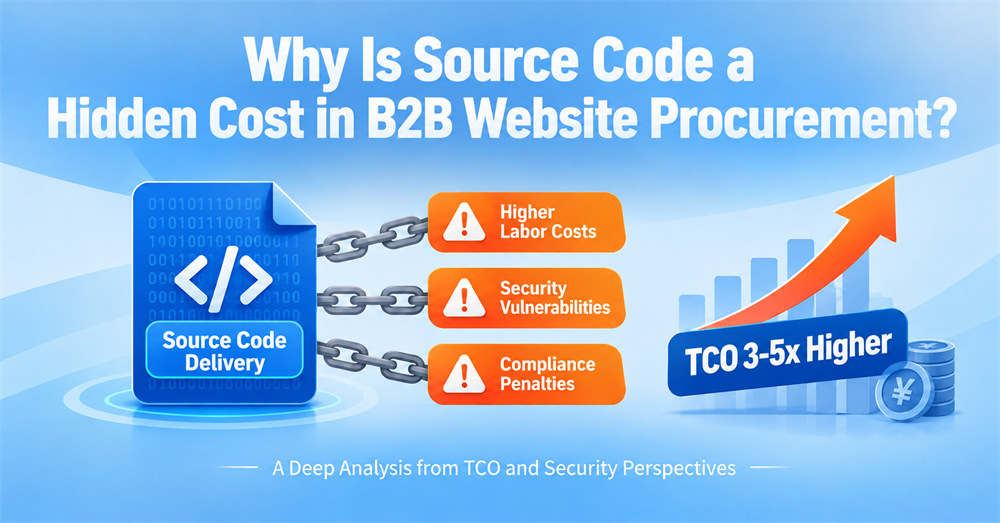
During the process of B2B foreign trade website development and digital procurement, many corporate decision-makers often raise a seemingly reasonable request: "Upon project delivery, we must receive the complete source code of the website."
The original intention behind this demand is easy to understand: most business decision-makers believe that holding the source code in their own hands equates to absolute control and a sense of security, and it avoids ongoing service fees in the future. However, under modern internet technology architectures, this traditional mindset is severely disconnected from the realities of actual business operations.
For export enterprises whose core goal is overseas customer acquisition, behind the apparent benefits of source code delivery lies a long-term, underestimated operational burden and hidden risks. Obtaining the source code not only fails to bring real security, but instead drags the enterprise into a quagmire of hidden costs (Total Cost of Ownership, TCO), subsequently triggering severe compliance and cybersecurity crises. This article will deeply analyze why B2B enterprises should abandon the obsession with "buying out the source code" from four dimensions: legal copyright, maintenance costs, security & compliance, and alternative service solutions.
1. Uncovering the Truth of Source Code Control: Legal Misconceptions About Copyright and Free Use
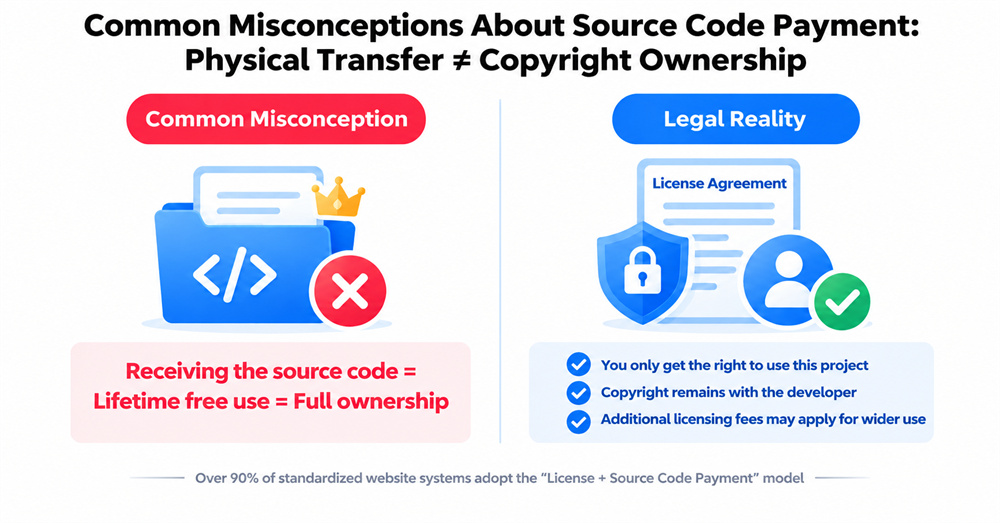
Many business decision-makers harbor a severe cognitive misunderstanding: they believe that simply packaging and copying the program's source code files to their own hard drives means the website belongs entirely to them, and they can use it for free permanently. This is untenable in both legal and business logic.
1. Copyright Boundaries: Physical Transfer of Source Code Does Not Equal Copyright Assignment
In standard commercial website development projects, the program code often includes underlying frameworks, proprietary CMS (Content Management System) cores, and third-party commercial plugins. These core components have clear copyright ownership. What clients obtain through payment is the commercial usage right for a single project, not the complete copyright of the code. Even if the service provider packages and delivers the source code, what is obtained is merely a usage license for a specific version, rather than the complete intellectual property rights and disposal rights of the underlying code.
2. Hidden Copyright Fees for Continuous Use
Industry data shows that over 90% of standardized website building systems in the domestic market currently adopt a collaboration model of "Authorized Use + Source Code Delivery." The copyright belongs to the developer, and the client only obtains a single-site usage license. Even if the client packages and transfers the source code to deploy it on their own servers, they still need to pay licensing fees to the original vendor or copyright holder once it involves the long-term commercial use of the core framework or the invocation of third-party commercial databases.
According to copyright law and common agreements in the website development industry, clients may only use the code in the corresponding project and are prohibited from secondary distribution, resale, or cross-project reuse. If used beyond the authorized scope, additional copyright fees must still be paid; the scenario of "free permanent use once obtained" simply does not exist.
If an enterprise unauthorizedly strips copyright declarations or cracks authorization modules for long-term free use, arbitrary secondary development, or even resale, it will face significant intellectual property litigation risks. In overseas markets that emphasize copyright, such as Europe and the United States, once it is discovered that the underlying code of a website involves infringement, the enterprise may subsequently face legal disputes and economic claims. This could even lead to the website being forcibly taken offline, directly impacting the export enterprise's global expansion strategy.
2. TCO Analysis: How Much Does It Really Cost to Maintain Independent Source Code?
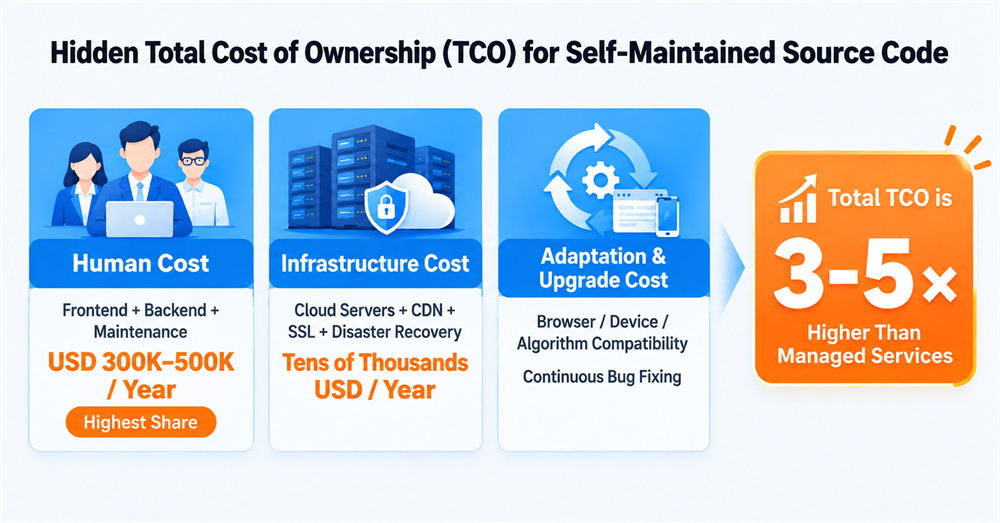
Calculated from a full lifecycle perspective, the Total Cost of Ownership (TCO) of maintaining source code in-house is typically 3 to 5 times that of a managed service, and costs will increase year by year as the website operates. Many enterprises only focus on the one-time payment during the website construction phase, completely ignoring the long-term continuous investment required after obtaining the source code.
1. Labor Costs: The Rigid Expenditure of Building an In-House IT Team
Once detached from the original vendor's SaaS or fully managed environment, owning the source code means the enterprise must independently build or maintain a professional IT technical team responsible for daily bug fixes, function adjustments, system adaptations, and other tasks.
To guarantee the stable operation of a basic independent export website, at least one front-end developer, one back-end developer, and one operations/maintenance personnel are required. Based on the salary levels in second-tier cities in China, the annual labor cost for such a team ranges from 300,000 to 500,000 RMB. Even if smaller enterprises use part-time staff for maintenance, the annual cost exceeds 100,000 RMB, with response speeds and service quality hard to guarantee. Many enterprises only calculate the initial website construction fee during procurement, entirely overlooking subsequent labor expenditures. In reality, the maintenance labor cost over 3-5 years is usually 3 to 5 times the initial construction fee; this is the most easily underestimated hidden cost.
2. Operations and Iteration: The Ignored Long-Term Infrastructure Investment
Besides labor costs, enterprises also need to independently configure or lease high-defense cloud servers, configure CDN acceleration nodes, purchase SSL certificates, and deploy database disaster recovery solutions. They must undertake operational tasks such as daily monitoring, data backups, and troubleshooting. The annual infrastructure maintenance cost ranges from tens of thousands of RMB.
Simultaneously, with browser version updates, mobile device iterations, and search engine algorithm adjustments, websites require continuous compatibility adaptation and functional optimization. Code that runs perfectly today might experience large-scale layout chaos in two years due to a new iOS system update or a Chrome engine upgrade. If static source code lacks continuous iteration by a professional team, various issues will quickly arise: for example, mobile page display errors, functional failures on new browser versions, and ranking drops following Google indexing rule adjustments. Many enterprises that obtained the source code find their websites riddled with bugs and declining compatibility 1-2 years after launch. Your internal IT team must constantly fix these bugs caused by technological shifts and expend significant effort designing adaptations for new hardware systems (such as new high-resolution monitors and emerging mobile devices). If they lack the capability for continuous repair, the ultimate outcome is tearing it down and rebuilding, resulting in duplicate investment.
3. Security and Compliance Traps: The Fatal Flaws of Static Code
In the B2B foreign trade sector, websites often host real corporate registration information, inquiry records, and even partial transaction data. In today's landscape of increasingly rampant cybersecurity threats, static code is extremely dangerous.
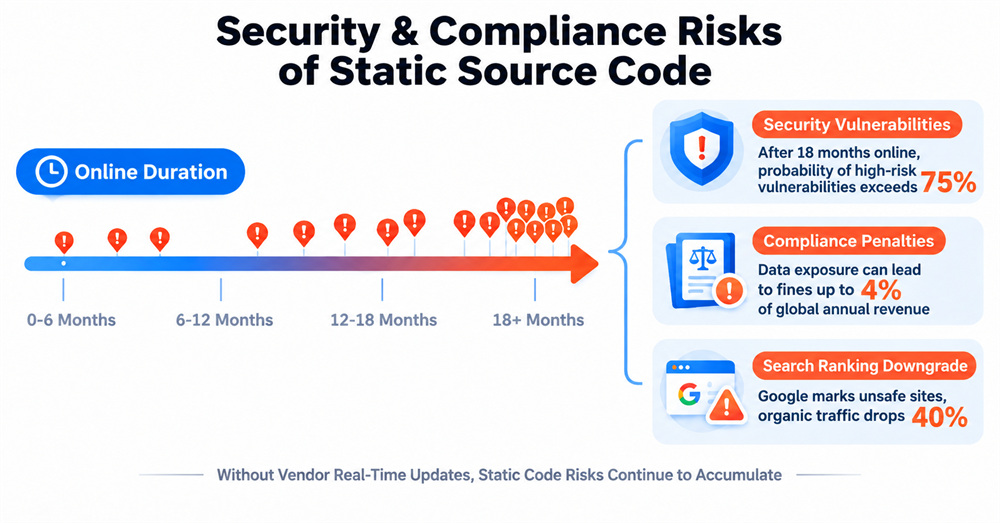
Lacking real-time updates from the original vendor, static code will expose an increasing number of security vulnerabilities over time. This not only affects the normal operation of the website but also brings penalty risks on the compliance front. This is a vulnerability that most enterprises find difficult to handle during self-maintenance.
1. Security Vulnerabilities: The Inevitable Shortcoming of Static Code
Static code without real-time updates from the original vendor is highly prone to vulnerabilities over time, leading to severe compliance risks. Once an enterprise takes the source code and deploys it independently, the clock on that code "stops." Hackers globally are constantly searching for backdoors in various open-source frameworks or legacy code every day. The original vendor's R&D team typically monitors these threats in real-time and regularly deploys security patches. However, enterprises holding independent source code often lack this acute cybersecurity awareness. The technical architecture of website systems relies on various open-source components and frameworks, which disclose new security vulnerabilities—such as SQL injection, XSS cross-site scripting, and file upload vulnerabilities—almost every month. Once a zero-day vulnerability appears in the underlying environment, without real-time update support from the vendor, the enterprise's official website becomes a sitting duck for hacker attacks.
According to public data from the cybersecurity industry, websites without continuous security maintenance have over a 75% probability of experiencing high-risk security vulnerabilities 18 months after launch. Most enterprises' own IT teams can only handle basic O&M issues and lack professional security defense capabilities. They are unable to discover and patch vulnerabilities promptly, often only realizing the problem after being attacked and suffering data breaches.
2. Compliance Risks: Mandatory Penalty Risks Under Global Regulation
Currently, global data compliance regulations are becoming increasingly strict. Regulations such as the EU's GDPR, the Russian Federation's Personal Data Law, and the California Consumer Privacy Act (CCPA) in the US all set clear requirements for website data security protection. If a website has security vulnerabilities leading to personal data leaks, the enterprise will face massive fines, up to 4% of its global annual revenue. Static source code cannot keep pace with updates in compliance requirements. For instance, upgrades to data encryption standards and adjustments to user privacy right response mechanisms all require code modifications. Self-maintained websites by enterprises often fail to complete compliance adaptations in a timely manner, facing the risk of regulatory penalties. Furthermore, the Google search engine flags websites with security risks as "Not Secure," directly lowering the site's search ranking and user trust. In our long-term service experience, we have found that enterprises experiencing Google ranking downgrades due to security issues on self-maintained websites suffer an average organic traffic drop of over 40%, with a recovery cycle lasting 3-6 months.
4. Managed Services: The Optimal Solution with Lower Costs and Higher Guarantees
The core logic of modern B2B procurement should be "paying for business results," rather than "paying for lines of code." For the vast majority of export enterprises, the wisest choice is to abandon the obsession with source code. Compared to the high costs and risks of self-maintaining source code, an original vendor-managed service is a model that better aligns with the needs of B2B enterprises.
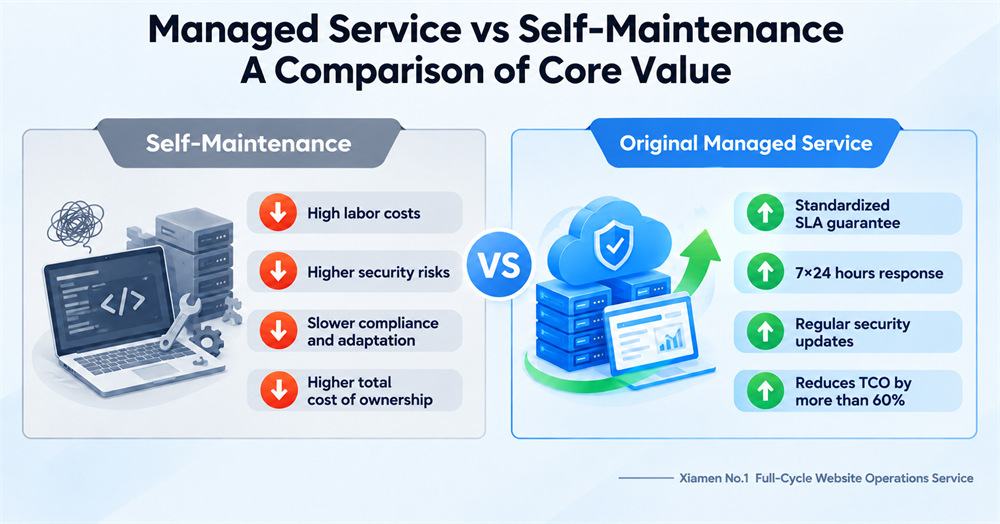
Taking the website development and maintenance services of Xiamen First Page as an example, we provide a standardized SLA (Service Level Agreement) covering full-lifecycle technical support and security guarantees, allowing enterprises to focus on their own business operations without worrying about the underlying code.
1. Standardized SLA: Quantifiable Service Guarantees
Our SLA writes all service commitments into the contract, including a 99.9% website uptime guarantee, a 24/7 fault response mechanism, core issue resolution within 4 hours, and regular security patch updates. Responsibilities and rights are clear, quantifiable, and verifiable. Enterprises do not need to monitor the website's operational status themselves; all O&M work is handled by our professional team, ensuring immediate response and resolution when problems arise.
2. Continuous Updates: Synchronized Technology and Security Iterations
We have a dedicated security and technical R&D team that tracks global security vulnerability intelligence and industry technology updates in real-time. We push security patches to all managed sites at the earliest opportunity to resolve potential risks. Concurrently, we keep pace with iterations in Google algorithm rules, browser standards, and terminal devices to continuously optimize website compatibility, indexing performance, and user experience. All updates are included in the service fee, with no additional hidden charges.
3. Cost Advantages: Reducing TCO by Over 60%
Calculated from the perspective of full-lifecycle TCO, the Total Cost of Ownership of a managed service is reduced by over 60% compared to self-maintaining source code. Enterprises do not need to hire dedicated IT teams, bear infrastructure costs like servers and security defenses, or pay extra for feature iterations and security upgrades. The annual subscription model is highly flexible, allowing enterprises to adjust service plans based on business needs and avoid massive one-time investments.
Many enterprises' obsession with source code fundamentally stems from a need for control and a sense of security. However, in reality, possessing the source code neither equates to complete ownership nor implies greater security. On the contrary, self-maintaining source code means bearing exorbitant labor costs, continuous infrastructure investments, and undeniable security vulnerabilities and compliance risks. The Total Cost of Ownership is far higher than that of managed services.
For export enterprises, the core value of a website lies in business customer acquisition, not in owning the underlying code. Choosing a professional provider's managed service—via standardized SLA guarantees, continuous technical updates, and security maintenance—not only secures more stable operational backing but also drastically reduces overall costs, enabling the enterprise to concentrate resources on its core business.
As a Google Premier Partner for 11 consecutive years, Xiamen First Page boasts 20 years of experience in foreign trade digital marketing, having served over ten thousand export enterprises. Our website development and operations services consistently center on business value, adhering to official compliance standards. We provide full-lifecycle technical guarantees and performance optimization, helping enterprises achieve stable and efficient overseas customer acquisition while keeping costs under control.
Appendix: FAQ on Website Source Code and B2B Website Development
Q1: After buying out the website's source code, can we use the website for free permanently?
Not exactly. Standard website program code contains numerous underlying frameworks and commercial plugins that hold independent copyrights. Obtaining the source code typically only signifies acquiring the usage rights for a specific version, not the full copyright. Following independent deployment, you still have to bear high server leasing costs and licensing fees for third-party commercial APIs, and you will need to hire IT technicians for long-term maintenance. It is not truly "free."
Q2: Why is it said that the cost (TCO) of self-maintaining website source code is higher?
Hidden costs (Total Cost of Ownership) include: expenses for leasing and configuring cloud servers, salaries for hiring professional IT operations staff and programmers, security defense costs to fend off cyberattacks, and the labor costs of continuously fixing code bugs as hardware iterates (such as new phone models and new browsers). This is usually far higher than the annual technical support service fee paid to the original vendor.
Q3: What are the risks of having static website code that lacks continuous updates?
The security and compliance risks are extremely high. Cybersecurity threats evolve daily. Static code that lacks real-time security patches and system upgrades from the original vendor is highly susceptible to exposing fatal vulnerabilities over time. This not only leads to website crashes or data leaks but also easily violates international data privacy regulations like GDPR, bringing compliance liabilities to the export enterprise.
Q4: If we don't hold the source code, how can we guarantee the security and stability of our export website?
The best solution is to sign an SLA (Service Level Agreement) with the service provider. For instance, through fully managed services provided by professional agencies like Xiamen First Page, enterprises can receive continuous technical support, regular security patch updates, and in-depth SEO architecture maintenance. This can drastically reduce the enterprise's comprehensive operational costs, allowing the foreign trade team to focus entirely on business conversion itself.