

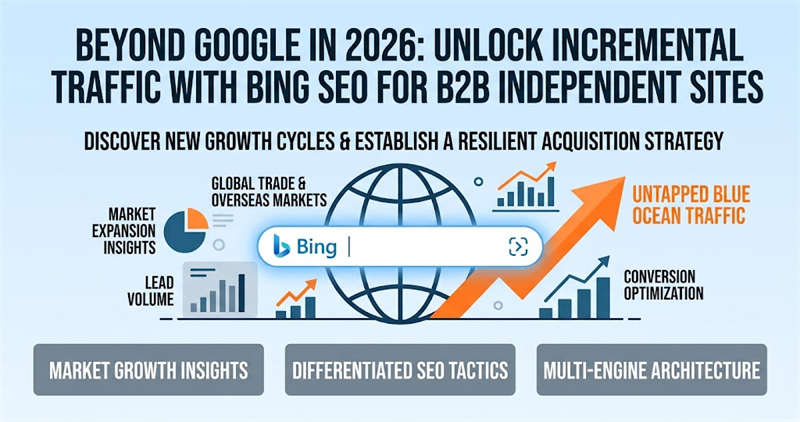
When export businesses invest in overseas SEO, they typically concentrate almost all of their resources on Google and, over time, overlook the incremental opportunity offered by the world’s second-largest search engine. As AI-powered search continues to advance and gain adoption, Bing’s market share and user quality have kept rising. In B2B procurement across North America and Europe in particular, it has become a high-value traffic channel that can no longer be ignored. This article looks at three dimensions—market-growth insights, differentiated optimization methods, and an overall multi-engine strategy—and sets out a practical Bing SEO guide to help export businesses unlock a second engine of growth and build a more resilient system for winning customers overseas.
1. Blue-Ocean Insights: AI-Driven Growth in the Bing Search Market
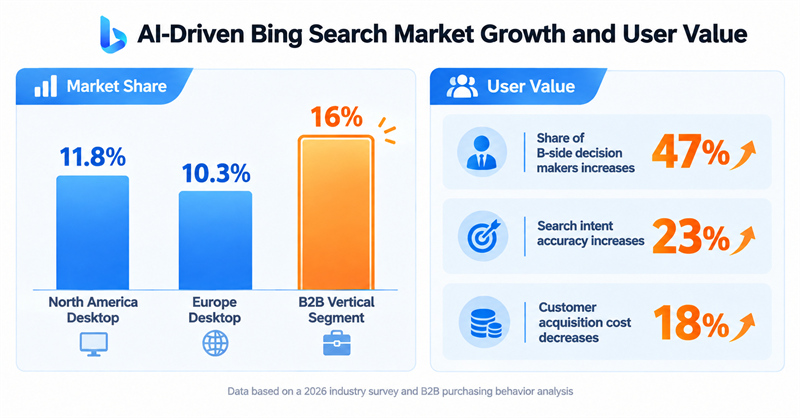
Over the past three years, the defining variable in the global search market has been the commercialization of AI, and Bing has been the fastest-growing mainstream platform in this shift. After Microsoft integrated Copilot deeply across Bing Search, user behavior has gradually moved from “information retrieval” toward “task completion,” steadily lifting Bing’s share of global desktop search. Industry monitoring data show that, by early 2026, Bing accounted for 11.8% of desktop search in North America and 10.3% in Europe. In verticals such as industrial procurement, B2B professional services, and technical equipment purchasing, its share has already exceeded 16%, and it continues to gain 1.5 to 2 percentage points a year.
In terms of user profile, Bing is markedly more commercial on the business side than general-purpose search platforms. Middle managers, procurement specialists, and technical engineers account for a share of its audience that is 47% higher than on general search platforms, and search intent leans toward product selection and comparison, supplier qualification review, technical solution validation, and bulk purchasing decisions. According to third-party research on B2B buying behavior, 38% of manufacturing procurement professionals in North America and Europe use Bing as their preferred tool for supplier research, because its AI-integrated results handle decision steps such as specification comparison and company background checks more efficiently. On export websites, inquiries from Bing are on average 23% more qualified than those from general search, and average order value is 18% higher. It is a classic source of high-value blue-ocean traffic.
Most export companies, however, still concentrate their SEO almost entirely on Google, leaving a clear structural gap. Based on a sample of export websites we have served, more than 70% have not carried out dedicated Bing optimization. Incomplete indexing, weak rankings for core keywords, and limited search-result presentation are common. For most of these sites, organic Bing traffic accounts for less than 3% of total search traffic—well below what Bing’s market share would imply—leaving at least three to five times the current volume as incremental headroom. For exporters that have already reached a ceiling on Google, Bing is a core, lower-cost entry point for incremental traffic.
2. A Differentiated Approach: Core Practical Points for Bing SEO
Bing and Google differ substantially in their underlying ranking logic, so a general optimization program built for Google does not fully transfer to Bing. Many companies simply copy their Google SEO plan onto Bing and see little return.
Plenty of fragmented tips circulate online, but complete, actionable Bing SEO guides are scarce, and much of the available material has not kept pace with Bing’s 2026 updates. A sound Bing search engine optimization guide cannot simply borrow Google SEO experience. It has to be built on Bing’s own ranking rules, user profile, and platform preferences. Drawing on Microsoft’s official documentation and extensive hands-on work by Xiamen First Page across a large number of export websites, we break the work into four core priorities.
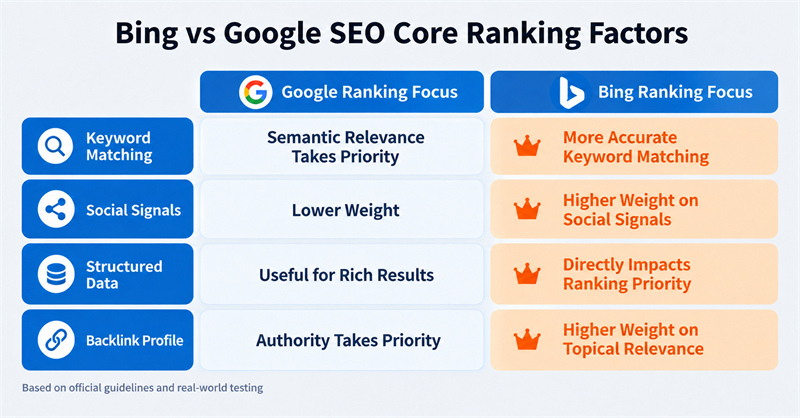
First, strengthen exact-match keywords and domain signals. Compared with Google, which places greater weight on semantic relevance and contextual understanding, Bing assigns more weight to exact matches. Exact-match domains that include core industry keywords enjoy a more pronounced ranking advantage on Bing than on Google; for new sites, the initial ranking lift from an exact-match domain is roughly 1.8 times that on Google. Exact keyword matches in the page title, the H1, and the first 100 words of body copy also have a stronger positive effect on Bing rankings. Provided readability is not compromised, it is reasonable to increase the precise frequency of core keywords, reinforce topical relevance, and avoid relying so heavily on semantic phrasing that topic recognition becomes unclear.
Second, take the ranking value of social signals seriously. Social signals are the dimension on which Bing and Google differ most, and the one export companies most often overlook. Google assigns very little weight to public social signals, whereas Bing treats brand mentions, content shares, and account engagement on social platforms as important authority signals. Signals from professional and industry platforms such as LinkedIn and X (formerly Twitter) carry the highest weight. Shares by recognized industry accounts, engagement with official company content, and brand mentions in industry groups all contribute positively to Bing rankings. Export companies can regularly publish technical briefings, product application cases, and company updates, and encourage industry users and partners to share them, gradually building social-signal authority.
Third, complete structured data and raise on-page content quality. Bing recognizes and uses Schema markup more readily than Google. Well-implemented product, organization, and FAQ structured data not only improves how results are displayed—earning more real estate and a higher click-through rate—but also directly raises a page’s ranking priority. Bing is also stricter about thin content. Pages that are short, information-light, or weakly original rarely rank well. Whereas Google can sometimes lift thin pages through backlinks, Bing tends to give greater weight to in-depth pages that are informationally complete. As a practical standard, core product pages and industry content pages should run to at least 800 words, cover specifications, use cases, and answers to common questions, and include the corresponding structured data.
Fourth, prioritize thematically relevant backlinks. While Google places heavy emphasis on site-level authority metrics such as DA and DR, Bing places greater emphasis on topical relevance. Links from sites in the same industry, upstream and downstream partners, and vertical trade media carry far more weight than links from high-authority sites in unrelated fields. One relevant link from a vertical industry publication can be worth roughly three to five links from high-authority general sites. When building links, prioritize partnerships in the same category and niche, industry directory listings, and reciprocal links with upstream and downstream companies. This outperforms the indiscriminate pursuit of high-authority domains and is more consistent with white-hat compliance.
In practice, export sites that make these dedicated adjustments in line with the Bing SEO guidance above typically see a clear improvement in indexing and rankings within two to three months. Well-established B2B sites, after six months of focused optimization, often see organic Bing traffic account for 12% to 18% of total search traffic and become a stable source of incremental inquiries.
3. A Portfolio Mindset: Building a More Resilient Independent Website Across Multiple Engines
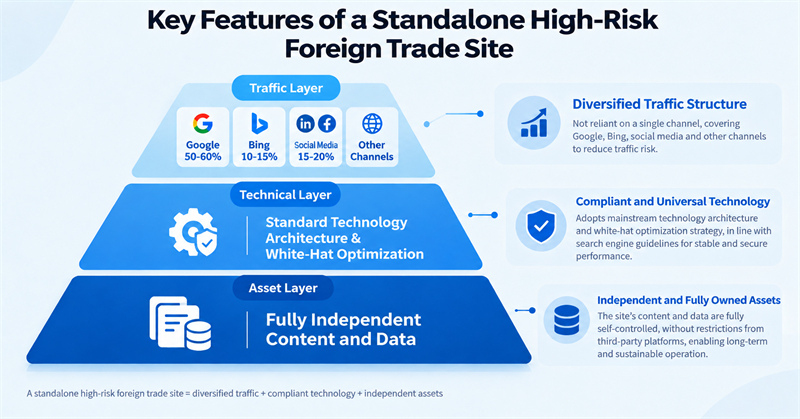
The long-term logic of overseas SEO has never been to push a single channel to its limit. It is to build a multi-channel traffic mix that offsets algorithm volatility on any one platform. Over the past five years, Google’s core algorithm has undergone three to four major updates a year on average, and each update has caused sharp traffic swings for roughly 15% of sites. For export businesses that depend heavily on a single search engine, that is uncontrollable systemic risk. In an era of full-funnel traffic, many practitioners ask what a truly resilient independent website actually looks like. At its core, it is a site that is not locked to a single platform, does not depend on a single traffic channel, owns its assets, and operates in compliance with platform rules.
A resilient export website has three defining characteristics. First, a diversified traffic mix: Google, Bing, social platforms, and vertical industry channels are all in place, no single channel exceeds 60% of traffic, and an algorithm shift on one platform cannot critically damage the business. A sound mix is typically 50% to 60% from the primary search engine, 10% to 15% from a secondary search engine, 15% to 20% from social and content marketing, and the remainder from channel partnerships and direct visits. Second, a technical architecture that is broadly compliant: the site meets the crawling requirements of all major search engines, uses white-hat methods, and does not rely on tactics aimed at a single platform, so a rule change on one platform will not trigger a sitewide penalty. Third, full ownership of content and data: all content, customer data, and user information reside on the company’s own site rather than in third-party platform accounts, so a policy change cannot erase those assets.
Real industry cases confirm the value of a multi-engine footprint. An export website selling mechanical components in East China previously derived 90% of its search traffic from Google and had done no dedicated Bing optimization. After a core Google algorithm update in 2025, rankings for its core keywords fell sharply, overall organic traffic dropped 32%, and inquiries stayed below the alert threshold for two consecutive months. The company then reset its overseas SEO strategy and built a multi-engine traffic system. It followed a Bing search engine optimization playbook to complete indexing, improve keyword rankings, and deploy structured data, while also developing social content channels such as LinkedIn and accumulating social signals. After three months, pages indexed by Bing increased by 140%, and core keywords entered the top 10. After six months, Bing accounted for 14% of site traffic and social for 11%. Overall organic traffic recovered and surpassed its pre-update level, and the business became substantially more resilient.
In 2026, competition in overseas SEO has shifted from rankings on a single search engine to the ability to build traffic across multiple channels. As the fastest-growing mainstream search channel in the AI search transition, Bing is an important, lower-cost entry point for incremental traffic and a core hedge against Google algorithm risk. Understanding how Bing and Google differ, optimizing for those differences, and building a multi-engine traffic mix are essential steps toward a more resilient site and steadier growth.
As a Google Premier Partner for 11 consecutive years, Xiamen First Page brings 20 years of experience in digital marketing for exporters and has served more than 10,000 export companies. Our overseas SEO services cover major global search engines, including Google and Bing, with end-to-end optimization from site architecture and content development to multi-channel traffic planning. We help companies build resilient export websites and achieve stable, efficient growth in overseas customer acquisition.