

In the red-ocean competition among cross-border e-commerce and overseas standalone sites, most foreign-trade companies fall into a familiar traffic anxiety: they keep scaling up ad spend, mass-producing content, and expanding backlink volume, yet the usual result is that traffic grows while inquiries and orders do not rise in step. Customer acquisition costs keep climbing, and return on investment is steadily squeezed. The root cause is not that these companies are not getting enough traffic. It is the lack of a systematic site-diagnosis framework—a precise “pulse check” of site health, competitive landscape, and conversion paths.
Only by using standalone-site analytics tools with real proficiency, assessing their own position objectively, and uncovering competitors’ strategic weaknesses—and then using those insights to guide standalone-site SEO execution and the iteration of promotion plans—can companies leave behind a blunt, cash-burning model and achieve stable, long-term growth.
I. The Tool Matrix: Combining Standalone-Site Analytics Tools to Uncover Gaps in Competitor Strategy
The industry offers a wide range of standalone-site analytics tools, and Ahrefs, Semrush, and Screaming Frog are the three most widely used mainstream options. Many foreign-trade teams have tool accounts, but most use them only to check keyword rankings and estimate website traffic. The tools become little more than simple lookup utilities, without a complete analytical logic. Industry research shows that fewer than 27% of foreign-trade companies can coordinate multiple tools and complete in-depth competitive diagnosis. Most companies tap less than 20% of a tool’s capability and, as a result, struggle to find real growth opportunities in the data. Each tool has a clear boundary of capability. No single tool can complete the full diagnosis. Only by combining them and cross-validating the results can companies reconstruct an accurate picture of their own operations and those of their competitors.
Semrush’s core strength is a panoramic breakdown of the market and competitor traffic. It can capture the mix of organic search, paid advertising, social traffic, referral links, and other channels, making it clear which types of keywords drive a competitor’s traffic and which countries and regions are its core acquisition markets. Many companies look only at organic traffic in competitive analysis and overlook the demand signals behind a rival’s paid campaigns. Semrush can feed high-converting paid keywords back to the SEO team as a reference for content development.
Ahrefs stands out in backlink profiling, historical keyword movement, and content-gap discovery. With Ahrefs, teams can review the referring domains behind a competitor’s backlinks, the distribution of anchor text, and the timeline of new and lost links, and distinguish whether those links come from industry media, partners, or low-quality spam. The keyword-gap feature can also surface terms where competitors rank and our site has no coverage at all, revealing blue-ocean long-tail opportunities. Ahrefs is weaker, however, at analyzing paid advertising and on-page technical issues, and it cannot complete in-site technical troubleshooting.
Screaming Frog is a local crawler focused on on-site technical SEO diagnosis, and it complements the two third-party platforms above. It can crawl every page on a site and batch-check issues such as dead links, redirect errors, duplicate meta tags, images missing alt text, disordered heading hierarchy, and structured-data errors. Many overseas standalone sites fail to gain traffic not because the content is weak or the backlink profile is thin, but because large numbers of product and blog pages cannot be crawled and indexed normally by search engines. All of that content work then goes to waste. Third-party tools can see only pages that have already been indexed, while Screaming Frog can uncover a large volume of hidden issues that never enter the index pool.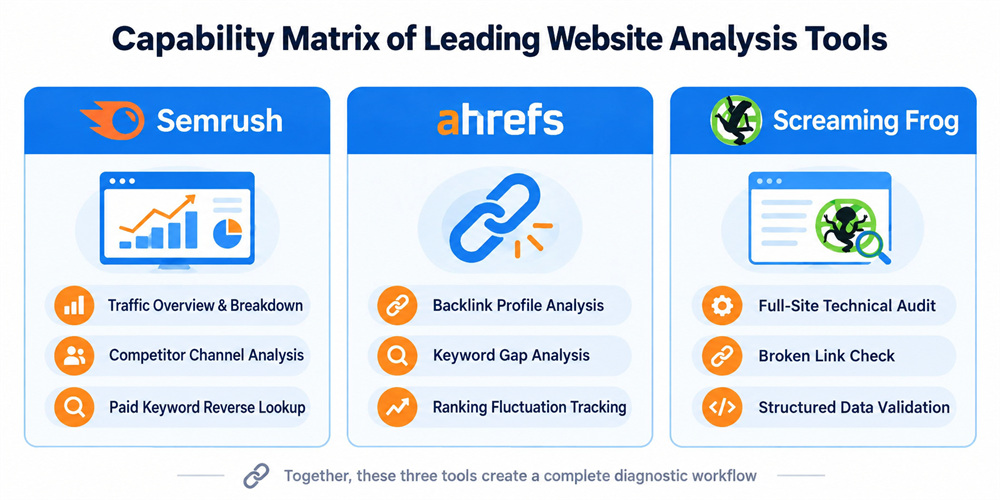
To truly uncover competitor gaps, teams cannot open data points in isolation. They need a standardized analysis process.
Step one is market traffic mapping. Use Semrush to select three to five direct competitors in the same category, measure the share of traffic by channel and the core target countries, and determine whether rivals rely on paid media or achieve lower-cost acquisition through organic search;
Step two is mining keyword and backlink gaps. Import the data into Ahrefs for a keyword-gap comparison, and filter for long-tail terms with moderate search volume, strong conversion intent, and moderate competition. At the same time, review the competitor’s backlink library and look for gaps in links from vertical industry media;
Step three is a technical-defect review. Use Screaming Frog to crawl competitors’ public pages and check for technical weaknesses such as large numbers of 404 pages, mobile-experience issues, and slow page loads.
One misconception needs to be clarified: finding a competitor’s weakness does not mean copying what that competitor does. Some of a rival’s problems may not be fatal to that rival, because high domain authority can cushion the impact. The value of identifying those gaps is to avoid the competitor’s weaknesses and turn overlooked demand, and technical work the competitor has not done well, into competitive barriers for our own site.
II. From Traffic to Inquiries: Data-Driven SEO Optimization and Promotion Execution
For operators of cross-border e-commerce and overseas standalone sites, the greatest value of analytics tools is not studying competitors. It is looking inward and turning data conclusions into executable standalone-site SEO actions and promotion plans. Many teams operate on the logic of “create content and run ads first, then look at the data,” which puts action first. A mature data-driven model is “data first, then execution, then review and iteration with data.”
In standalone-site SEO, data diagnosis should run through the full process of on-site optimization, content production, and backlink building. The first priority is a site-health review: regularly crawl the full site with Screaming Frog and map indexing barriers, including dead links, ineffective redirects, duplicate titles and descriptions, unoptimized images, and page-speed issues. Many foreign-trade websites have been live for two or three years, with products launched and retired hundreds of times. Abandoned pages accumulate and go untreated. A large share of crawl budget is consumed by useless pages, so new products and core blog articles remain unindexed for a long time. Fixing these technical issues first often produces a modest lift in traffic to existing pages, without a large volume of new content.
The second priority is tiered keyword management. Use Ahrefs and Semrush to segment the site’s existing keywords: core terms with high rankings and high conversion, broad traffic terms that rank but convert poorly, and long-tail terms with search demand that the site does not cover at all. Many companies chase head terms with tens of thousands of searches and invest heavily, while ignoring long-tail terms with only dozens or hundreds of searches that convert into inquiries extremely well. Competition for head terms is an industry-wide race. Precise long-tail terms reach B2B buyers who already have a clear purchasing need. Resources should be allocated by tier: for core converting terms, prioritize page content, backlinks, and on-page trust signals; for long-tail terms, plan coverage through blogs, product detail pages, and FAQ pages; for broad terms that bring traffic but almost no inquiries, reduce the resource allocation.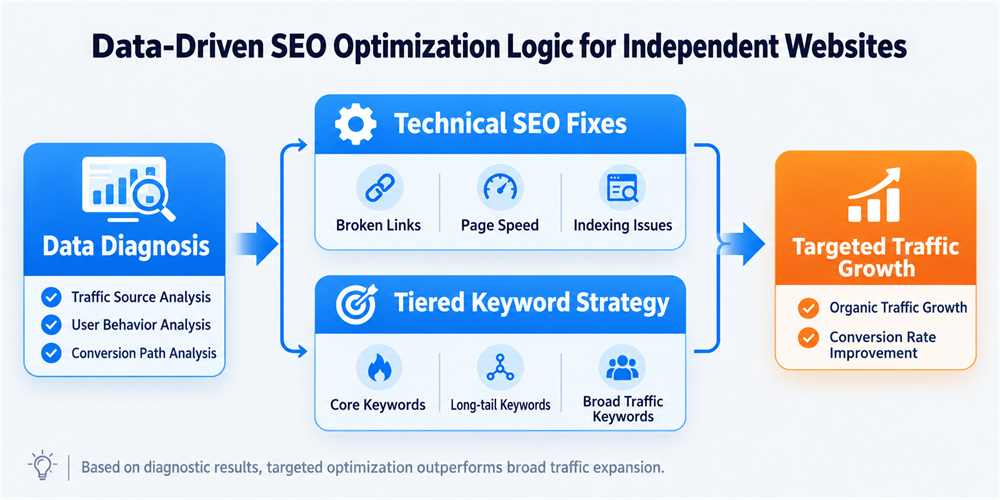
In standalone-site promotion, the core role of data analysis is to optimize budget allocation and improve efficiency while reducing cost. Promotion for foreign-trade standalone sites spans paid search, social advertising, email marketing, and backlink content marketing. Without tracking, budgets easily tilt toward surface-level traffic. Many ads generate high visit volume, but visitors stay briefly and bounce at very high rates. That is ineffective traffic, and continued spend only consumes budget.
A complete data-driven promotion logic has three layers:
First, differentiate channel performance. Compare bounce rate, average time on site, and inquiry submission rate across acquisition channels, and identify which channels bring genuinely interested prospects;
Second, analyze the landing-page conversion funnel. The same traffic sent to different pages can produce very different inquiry results. Use the data to find weak points in conversion and improve trust elements such as form placement, product descriptions, customer cases, and credentials;
Third, adjust budgets dynamically. Cut spend on high-cost, low-inquiry channels and shift it to high-ROI channels.
It is important to be clear-eyed: data analysis does not create inquiries directly. Its role is to reduce blind trial and error. SEO and promotion without data support are like shooting with your eyes closed—luck may hit the target, but the result cannot be repeated. A data-driven approach helps teams keep calibrating direction and put limited people and budget into higher-certainty opportunities. At the same time, all traffic and keyword figures from third-party standalone-site analytics tools are estimates. They are suitable for side-by-side comparison and trend reading, not as actual website visit data. Real performance must be cross-checked against Google Analytics in the site backend.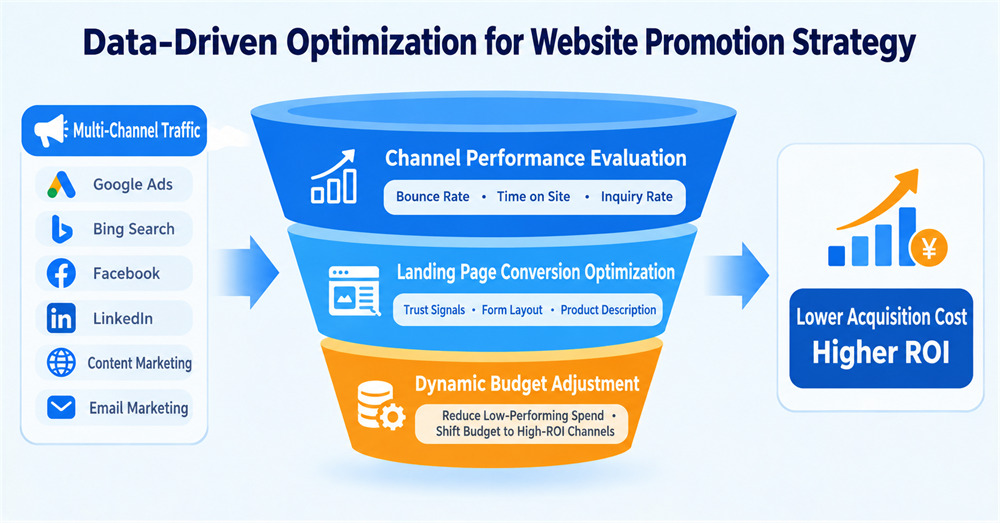
III. Common Pitfalls in Data Diagnosis and the Right Approach
Many foreign-trade teams buy a full set of tools and still miss the expected results, usually because they fall into common pitfalls in how data is applied.
The first pitfall is overvaluing numerical metrics and losing sight of the business itself. Teams chase estimated traffic and authority metrics such as DR and DA, turning the operating goal into inflating domain scores while ignoring inquiries and orders. The ultimate goal of an overseas standalone site is to win inquiries from overseas customers. High authority is only a means to that end, and the means cannot be treated as the end itself. Some sites do not stand out on DR, yet nearly all of their traffic comes from high-intent B2B purchasing keywords, and their inquiry performance far exceeds that of some high-DR sites flooded with unqualified traffic.
The second pitfall is treating diagnosis as a one-time exercise and then shelving it. Markets, competitors, and search-engine rules all change continuously. Competitors add content and earn new backlinks, and user search habits also shift with the market. A standalone-site pulse check is not a one-off project. It needs a regular monthly and quarterly review. Complete a basic data review every month and a deep competitive benchmark every quarter, so newly emerging opportunities and risks are caught in time.
The third pitfall is copying a competitor’s playbook and replicating everything the rival does. A competitor’s actions are fitted to its own resources and stage of development, and a direct copy is not necessarily right for your company. Where a competitor performs well, analyze the logic behind it. Where a competitor has gaps, avoid them. Do not mechanically replicate whatever a rival does. Data analysis is about understanding “why,” not simply imitating “what.”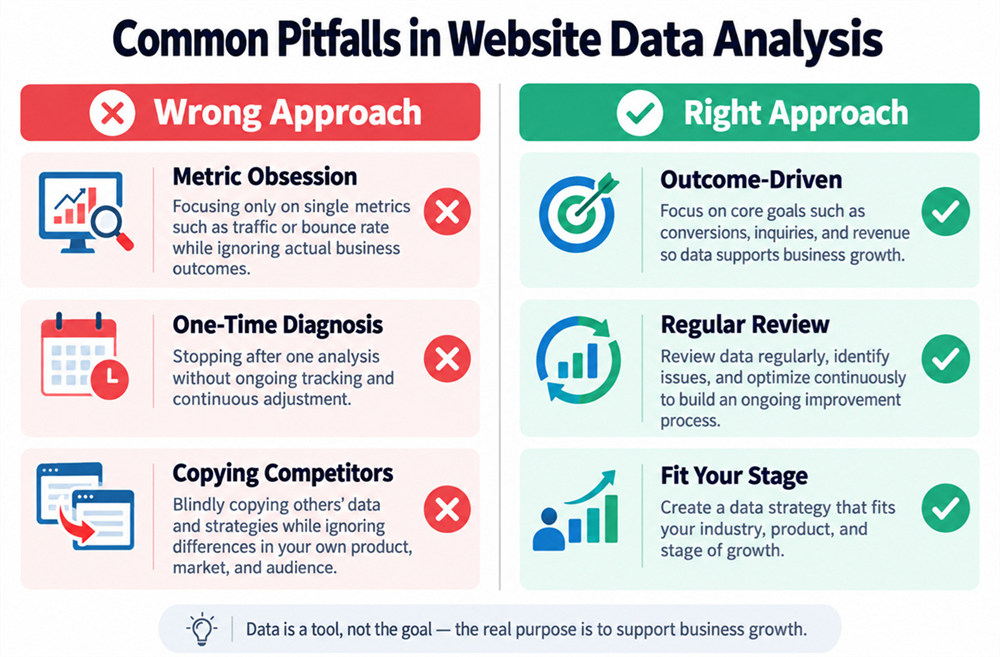
As a Google Premier Partner for 11 consecutive years, Xiamen First Page has 20 years of experience in foreign-trade digital marketing and has served more than 10,000 foreign-trade companies. We have a complete matrix of standalone-site analytics tools and a professional data operations team, and we provide end-to-end services from site diagnosis and SEO optimization to precision promotion, helping foreign-trade companies move past traffic anxiety and achieve genuine data-driven growth.