

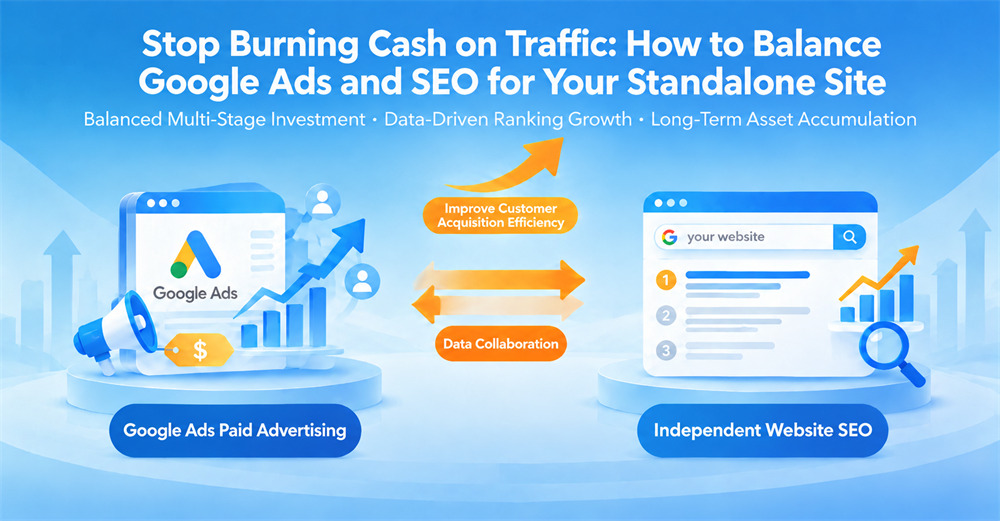
This article examines the budget-balancing logic between Google Ads management and standalone-site SEO at different stages of growth for cross-border e-commerce and B2B foreign-trade standalone sites. It explains how to use Google Ads data to feed back into page optimization, addresses at the root the question of how to improve a website’s Google rankings, and shows how to move from “burning cash for traffic” to “asset-building growth.”
In the overseas customer acquisition systems of foreign-trade standalone sites, Google Ads management and standalone-site SEO are often treated as two mutually exclusive paths. Some companies see advertising as “burning cash for traffic”—when the spending stops, the traffic stops—and prefer to rely purely on slow SEO accumulation. Others chase rapid volume, investing heavily in ads while neglecting SEO infrastructure, and end up stuck with high customer acquisition costs over the long term. In essence, both views overlook the value of synergy between channels. For cross-border e-commerce standalone sites and B2B foreign-trade standalone sites alike, the core path to better acquisition efficiency is to balance investment dynamically according to the site’s stage of development and to use advertising data to feed back into SEO optimization.
I. Balancing Investment by Stage: A Budget Allocation Logic That Matches the Site Lifecycle
Key takeaway: Ad management and standalone-site SEO are not a zero-sum game. The investment ratio should be adjusted dynamically according to the site’s stage of development, balancing short-term acquisition with long-term asset building. Sites with different business models call for clearly different investment strategies.
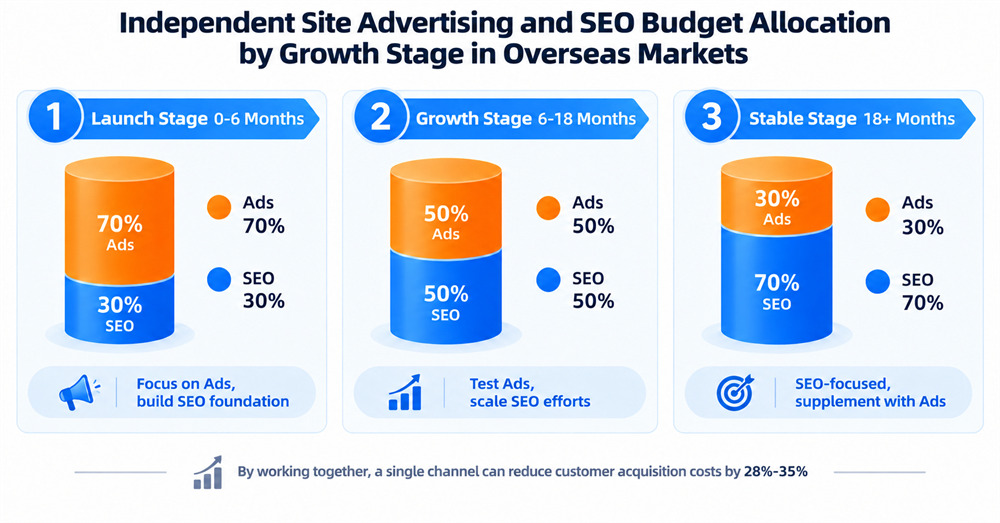
1 New-Site Launch Phase (Months 0-6): Ads Lead, SEO Lays the Foundation
At this stage, the site is only partially indexed and has no ranking foundation. SEO traffic takes a long time to build, so Google Ads management is the core entry point for targeted customer acquisition.
Budget ratio: Ads and SEO are typically split 7:3.
Key actions: Ads handle rapid testing of products, markets, and keywords and bring in qualified inquiries. SEO focuses on building the foundational technical architecture, placing core keywords, and optimizing indexing, laying the groundwork for future organic traffic growth.
Differences by model: Cross-border e-commerce standalone sites have short conversion paths and fast decisions, so the ad share can be raised appropriately during launch to quickly validate market acceptance of the products. B2B foreign-trade standalone sites have long decision cycles and place a high weight on trust, so the share devoted to foundational SEO content and authority building should be somewhat higher, to avoid the trust deficit that pure advertising creates.
2 Growth Phase (Months 6-18): Ads Test, SEO Captures
The site has completed basic indexing, core keywords are gradually gaining rankings, and SEO traffic is entering its release phase, so budget shifts progressively toward SEO.
Budget ratio: Ads and SEO are typically adjusted to 5:5.
Key actions: The focus of Google Ads management moves from broad traffic acquisition to testing new keywords, expanding into new markets, and defending against competitors. At the same time, high-converting keywords and topics that have been validated are carried into the SEO program to widen the reach of organic traffic.
Core value: The rapid testing capability of ads lowers the trial-and-error cost of SEO and drives steady growth in organic traffic.
3 Stable Phase (18+ Months): SEO Leads, Ads Supplement
The site’s organic traffic system has matured, SEO has become the main source of traffic, and ads take on a supplementary role.
Budget ratio: Ads and SEO are adjusted to 3:7.
Key actions: Ad management concentrates on incremental traffic in peak season, defending core keyword rankings, remarketing to existing customers, and clearing slow-moving inventory. SEO continues to expand long-tail keyword coverage, deepen content authority, and reinforce ranking barriers.
Results: Organic traffic typically accounts for more than 60% of the total, overall customer acquisition cost falls to its lowest level, and the site’s resilience against traffic risk improves markedly.According to service data from Xiamen First Page, foreign-trade standalone sites that adopt a stage-based, coordinated investment strategy achieve overall customer acquisition costs 28%-35% lower than those relying on a single channel, and a long-term return on investment more than 40% higher.
II. The Core of Coordinated Growth: Ad Data Feeds SEO to Improve Search Rankings Systematically
Key takeaway: The full-funnel conversion data accumulated through Google Ads management is a precise basis for guiding SEO optimization, and it addresses at the root the question of how to improve a website’s Google rankings.
At many companies, Google Ads management and standalone-site SEO sit with different teams or service providers, and their data is completely siloed. The high-value search terms and conversion data produced by ad campaigns never make their way into the site, so when the ads stop, the traffic stops, and no long-term asset is built. This is the main reason many companies see advertising as “burning cash.”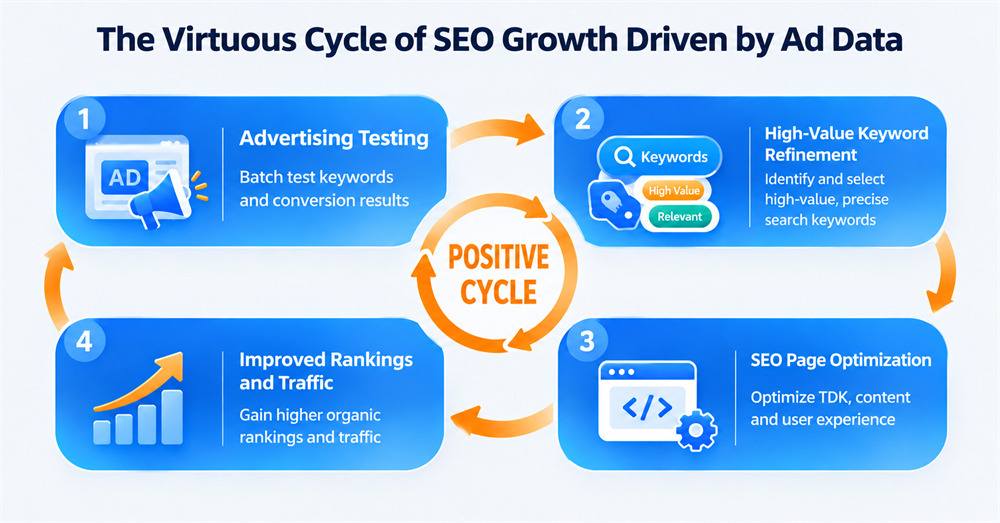
1 Capturing High-Converting Keywords to Optimize Page TDK and Content Layout
Ad management can test the clicks, conversions, and inquiry quality of a large number of keywords in a short time and identify the precise search terms that carry real commercial value. These terms come from genuine user search behavior, and their conversion efficiency is far higher than that of the broad-traffic terms surfaced by keyword tools.
How to apply it: Work the high-converting terms into the titles, H1 tags, core body paragraphs, and structured data of product pages and category pages, to improve page relevance in a targeted way.
Proven results: For high-converting terms validated through ads, rankings improve 18 times faster after SEO optimization than for generic keywords, and the traffic converts at a higher rate.
2 Using Conversion Data to Validate Content Direction and Guide SEO Content Planning
At many companies, SEO content production relies on industry experience, which easily yields content that the team considers valuable but users do not care about, resulting in an extremely low return on investment.
How to apply it: Use the conversion data from ad management to validate how well different topics, scenarios, and questions are received and how well they convert. This reveals the pain points, needs, and decision criteria that target customers truly care about, and guides the planning of SEO content such as blog posts, FAQs, industry solutions, and application cases.
Core value: The content produced is already closely matched to user search intent, so once indexed it is more likely to earn a top ranking and to bring in genuine inquiries, avoiding wasted investment in ineffective content production.
3 Optimizing User Signals on Landing Pages to Strengthen Search Authority in Return
Google’s search algorithm places growing weight on user behavior signals at the page level, including click-through rate, time on page, bounce rate, and conversion completion rate. These signals directly affect page rankings.
How to apply it: Use the targeted traffic generated by ad management to quickly test the conversion performance of different landing pages and find the best page layout, content structure, form path, and trust elements. Then roll the winning page approach out across the site’s SEO pages.
The virtuous cycle: This creates a closed loop of “ad testing → page optimization → stronger signals → higher rankings → more organic traffic,” continuously driving up natural authority.
III. Proven in Practice: A Case Study in Acquisition Efficiency Gains from Coordinated Operations
Case background: A B2B foreign-trade standalone site selling industrial fasteners in East China had previously run ads and SEO separately, with no data sharing between them and a low return on investment.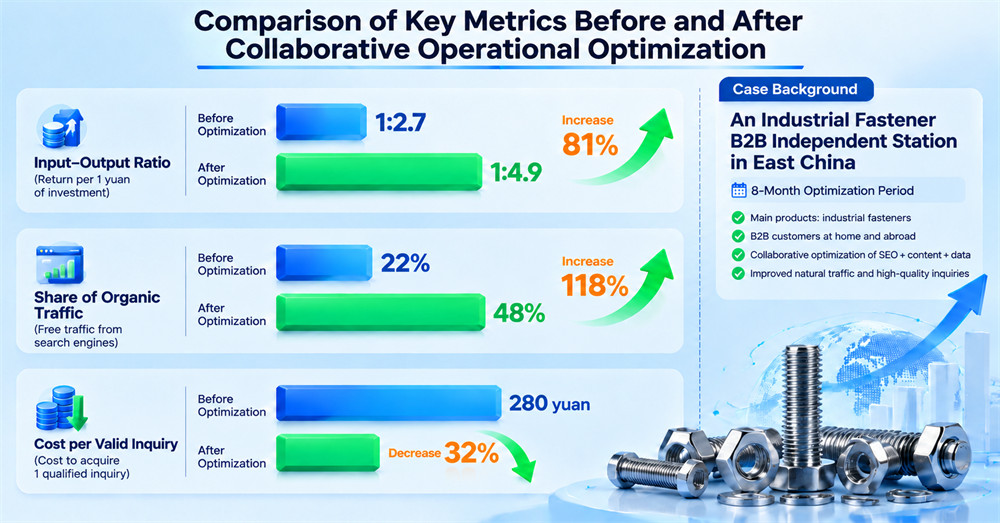
Situation Before Optimization
Investment pattern: The monthly ad budget was RMB 40,000, with a cost of about RMB 280 per qualified inquiry. SEO spending was RMB 150,000 per month, yet core keyword rankings improved slowly.
Core problems: The data was completely siloed. The high-value terms tested through ads were never carried into SEO, and traffic dropped immediately when ad spend stopped. Organic traffic made up only 22% of the total.
Return on investment: After one year of operation, the overall ROI was only 1:27, far below the industry average.
Optimization Actions
The site partnered with Xiamen First Page to bring Google Ads management and standalone-site SEO into a single, coordinated operating system:
1 Break down the data barriers. From six months of ad data, 62 high-converting, low-competition long-tail product terms and scenario terms were selected. The TDK and core content of the corresponding product pages and category pages were optimized accordingly, and matching FAQ and application-scenario content was added.
2 Adjust the budget structure dynamically. In the first three months, ads accounted for 65% of the budget, enabling rapid testing to expand the keyword pool. As SEO traffic grew, the split was adjusted to 4:6 by month six.
3 Use the conversion test results from ad landing pages to optimize the form layout, customer case studies, and credential display modules across all product pages, improving page conversion efficiency and user behavior signals.
Results After Optimization
After 8 months of coordinated operations:
Rankings: The number of core keywords ranking in the top 10 organically grew by 110%.
Traffic mix: The share of organic traffic in total traffic rose from 22% to 48%.
Cost efficiency: The overall cost per inquiry fell by 32%, and ROI rose to 1:49.
Model shift: The site moved from “burning cash for traffic” to “building long-term assets.”
IV. Three Common Misconceptions About Coordinated Operations
1 Misconception One: Treating the Two as Zero-Sum Competitors
Some companies believe that a larger ad budget will squeeze out SEO investment, and vice versa. In reality, the two are complementary: ads deliver short-term targeted acquisition and rapid data testing, while SEO builds long-term assets and lowers long-term costs. The value of coordination far exceeds that of any single channel.
2 Misconception Two: Failing to Capture Ad Data, So the Learning Ends When the Spend Ends
Many companies focus only on short-term conversions in their ad management and never carry the high-value keywords, user preferences, and conversion paths they have tested into their SEO program. As a result, they keep spending on ads without ever building an organic traffic moat, and remain trapped in a cycle of high-cost acquisition.
3 Misconception Three: Rigid Budget Allocation That Does Not Adjust by Stage
Some companies stick to a fixed investment ratio throughout. They overinvest in SEO during the new-site phase and miss the window for rapid growth, or keep a high ad budget in the stable phase while customer acquisition costs stay elevated. The budget strategy must be adjusted dynamically to match the site’s stage of development in order to maximize returns.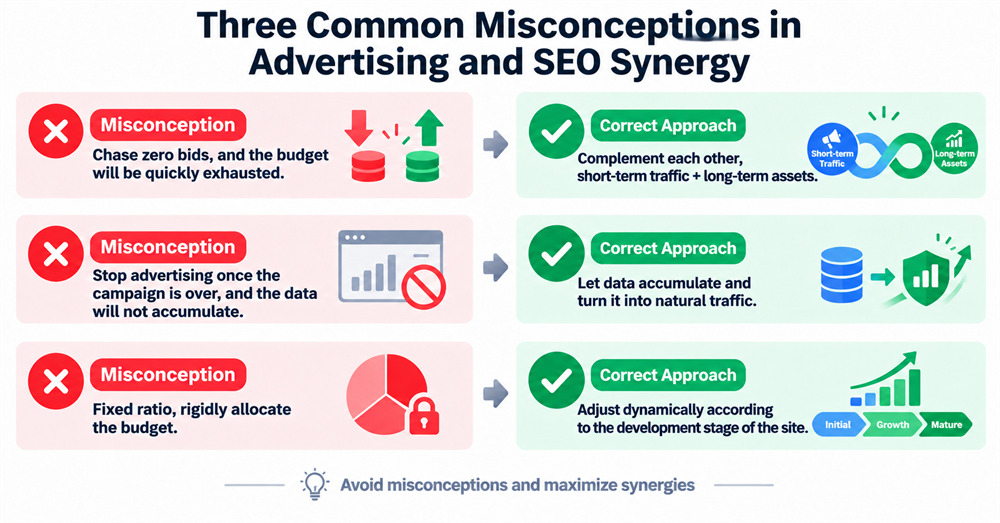
Google Ads management is not simply about burning cash, and standalone-site SEO is not an inefficient long-term investment. Run in coordination, the two meet a company’s short-term need for targeted acquisition while building long-term organic traffic assets, making them the core path to efficient customer acquisition for foreign-trade standalone sites.
As a Google Premier Partner for 11 consecutive years, Xiamen First Page has 20 years of experience in foreign-trade digital marketing and has served more than 10,000 foreign-trade companies. We provide integrated, end-to-end acquisition services that combine Google Ads management and standalone-site SEO, breaking down the data barriers between ads and SEO. We adjust investment strategies dynamically to fit the different models and stages of development of cross-border e-commerce standalone sites and foreign-trade standalone sites, helping companies systematically solve the question of how to improve a website’s Google rankings and achieve stable, sustainable overseas business growth. Call or message us on WeChat for a consultation: 18855144825.