

After building an independent export website, slow indexation of the new site and delays in pages entering the search index are common operational pain points for many export enterprises. Some companies attribute this indexing stagnation to fierce industry competition, or simply wait for natural crawler discovery, while ignoring standardized indexation configurations and systematic indexing optimization post-launch. Clarifying the standard Google SEO indexation steps after building the site, and mastering Google crawler indexing optimization techniques and indexation acceleration methods, are the core foundations for new sites to quickly break through indexing bottlenecks and acquire organic traffic.
This article systematically outlines the standard full-process actions for indexation after a new site goes live, and explains Google website indexation optimization methods in detail, providing an actionable indexation execution framework for new export sites.
I. Standard Google SEO Indexation Steps After a New Site Goes Live
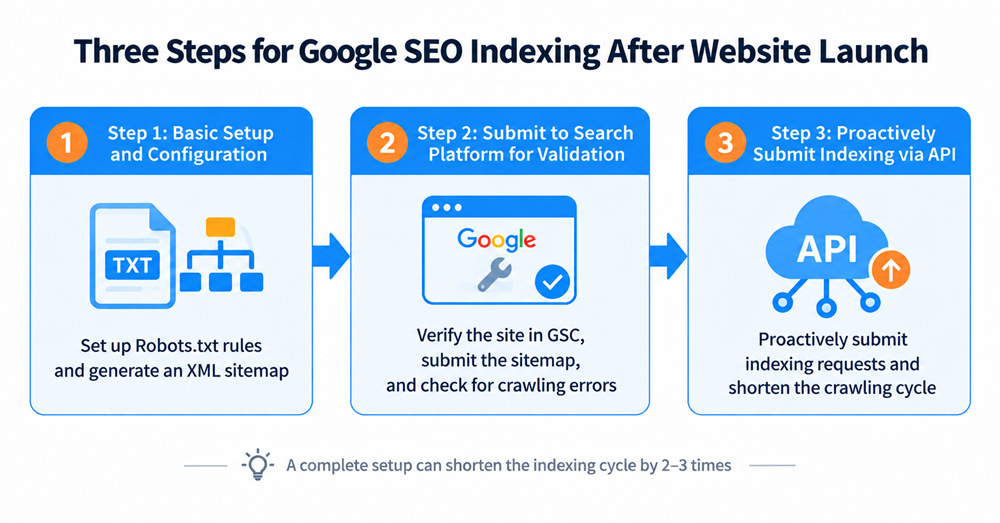
Completing the construction of an independent website does not equate to the start of its operation. Only by completing comprehensive indexation configurations can search engines properly discover, crawl, and index the site's pages. The standard Google SEO indexation process consists of three indispensable core stages.
1. Basic Crawl Configuration: Robots.txt and Sitemap Specifications
Robots.txt is the first rule file that search engine crawlers access when visiting a site. It specifies which pages are allowed to be crawled and which are disallowed. The root cause of abnormal indexation for many new sites often lies in incorrect Robots.txt configurations—either mistakenly blocking core product pages and directories, or exposing a large number of useless pages such as backend systems and filter results, which dilutes the crawl budget.
The correct configuration logic is: allow crawling for core index pages such as the homepage, product pages, category pages, and blog post pages; disallow low-value pages like backend pages, user centers, search result pages, and pagination parameter pages; and explicitly state the URL of the sitemap. The Sitemap is the core file that guides crawlers to discover pages in bulk. A standard sitemap should be layered by page type, generating separate map files for products, blogs, categories, etc., and accurately marking the last modification time and update frequency for each URL. After a new site goes live, a standardized XML sitemap must be generated first to ensure all core pages are included without any redundant or invalid links.
2. Search Console Submission and Verification
After completing the basic configurations, you need to verify the site on Google Search Console (GSC). This is the official site management portal and the core channel for submitting pages for indexation and checking crawl status. Once verified, first submit the sitemap file to trigger Googlebot's bulk crawl scheduling; next, use GSC's URL Inspection tool to test the crawlability of core pages and troubleshoot issues like server errors or inaccessible pages; meanwhile, review the site's crawl error reports to promptly fix pages with abnormal statuses like 404 or 500 errors. This step is the foundation of indexation. Many companies skip this step after building their site and simply wait for natural crawling, which extends the indexing cycle by 2 to 3 times.
3. Proactive Pushing via Indexing API
For new sites, relying solely on crawlers to naturally discover pages is very slow. The Google Indexing API is one of the official methods to accelerate indexation. Although this interface was originally designed for time-sensitive content scenarios, it is equally applicable to the core pages of new export sites. Once configured, you can proactively submit indexing requests to Google after publishing new pages to notify the crawler to visit. A single account can push up to 200 URLs per day, and the crawler's response time is usually between a few hours to two days, which is much faster than the 1 to 2 weeks required for natural crawling. It should be noted that API pushing only proactively notifies the crawler and does not guarantee indexation; the final result still depends on page quality.
II. Core Reasons for Slow Indexation of New Sites and Google Crawler Indexing Optimization Techniques
After completing the basic indexation steps, if pages are still not indexed for a long time, the problem usually lies in the crawling process or page quality. Applying targeted Google crawler indexing optimization techniques to resolve core obstacles is essential to effectively boost indexing efficiency.
1. Crawl Path Optimization: Streamlining Internal Link Hierarchy
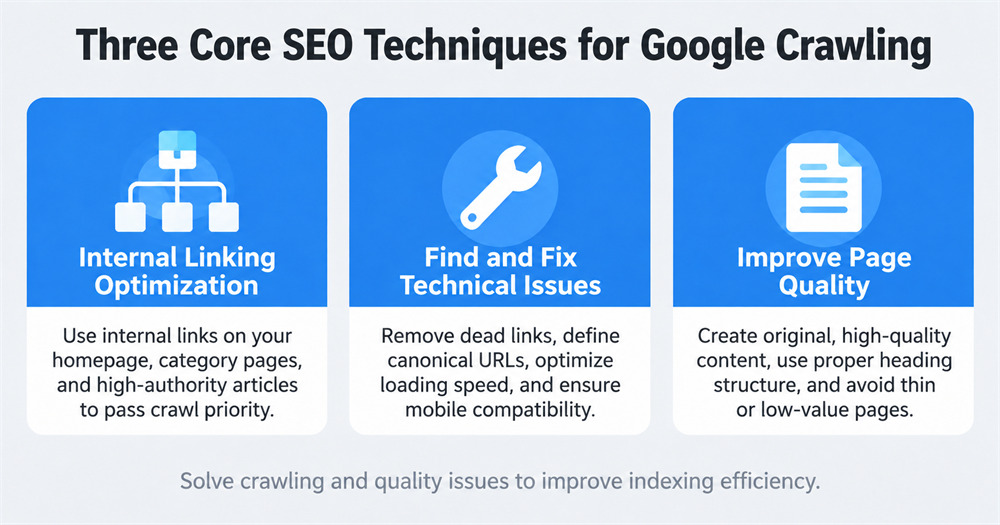
Googlebot discovers new pages through links between pages. The internal link structure directly determines the crawler's efficiency and page discovery rate. For many new sites suffering from slow indexing, the core issue is an overly deep internal link hierarchy and the presence of numerous orphan pages. Crawlers typically prioritize pages within 3 clicks from the homepage; pages beyond 4 levels are rarely found. Additionally, orphan pages without any internal links pointing to them are virtually impossible for crawlers to locate. The corresponding optimization techniques are: build a flat site architecture, ensuring the click depth from the homepage to any core page does not exceed 3 levels; perfect the internal link system, including global navigation, breadcrumbs, category hubs, and related product recommendations, so that every core page has at least 2 to 3 entry points; and after a new page goes live, promptly add backlinks to it from already-indexed high-authority pages to guide the crawler.
2. Technical Obstacle Troubleshooting: Clearing Crawl Anomalies
Technical crawl barriers are also highly frequent causes of slow indexing for new sites. Common issues include: slow server response where page load times exceed 3 seconds, significantly reducing the allocated crawl budget; the presence of numerous dead links and invalid redirects on the site, lowering crawl efficiency; pages utilizing excessive dynamically loaded content that crawlers cannot fully recognize; and poor mobile adaptability that violates mobile-first indexing rules. Corresponding optimization techniques include: optimizing server response speed to keep page load times under 2 seconds; regularly crawling the entire site to clean up 404 dead links and fix erroneous redirects; employing static rendering for core content to ensure crawlers can read complete information; and ensuring proper mobile optimization to meet mobile-first indexing standards. These are fundamental Google website indexation optimization methods and the core to improving crawl efficiency.
3. Page Quality Enhancement: Meeting Indexation Standards
Google does not index all crawled pages. It conducts quality assessments, and low-quality pages are excluded from the index. Common quality issues on new sites include: page content that is too short and low in information density; massive duplicated or homogenized content with no original value; pages containing empty content, placeholders, or missing core information; and excessive keyword stuffing, resulting in poor readability. The corresponding optimization techniques are: ensure the word count for core product pages and article pages is no less than 600 words, covering complete product parameters, application scenarios, and FAQs; guarantee content originality by producing exclusive content tailored to industry and product characteristics; perfect page meta-information with clear hierarchies for titles, descriptions, and H tags; and avoid keyword stuffing to maintain natural readability. Only pages that meet quality standards will be included in the valid index.
III. Google Indexation Acceleration Methods: Proactively Boosting Indexing Efficiency
Building upon the completion of basic configurations and troubleshooting, proactive operational measures can further shorten the indexation cycle. This is also an essential component of Google website indexation optimization methods.
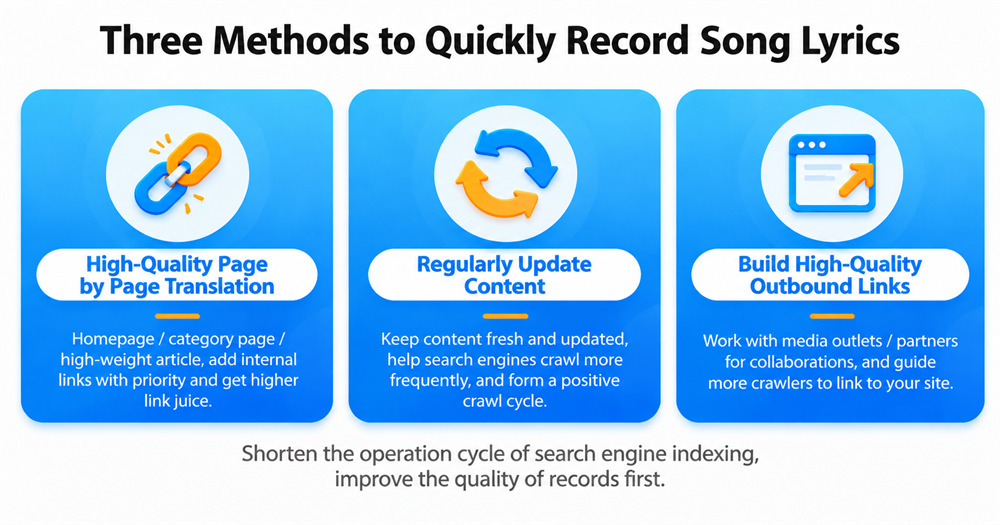
First, passing link equity from high-authority pages. After a new page goes live, prioritize adding internal links pointing to it from the homepage, core category pages, and already-indexed, high-authority blog posts. These high-authority pages have high crawl frequencies. When the crawler revisits, it will quickly discover the new page while passing on page equity, thus increasing its indexing priority.
Second, a regular content update rhythm. Maintaining a fixed frequency for content updates, such as publishing 2-3 industry blog posts or updating product information weekly, helps cultivate crawler habits and boosts the site's crawl frequency. After each content update, promptly update the sitemap and submit it to GSC, combined with API pushes for core pages, to form a positive cycle of "Update - Submit - Crawl".
Third, guidance through high-quality external backlinks. Obtain backlinks from external sites via industry media reports, partner site link exchanges, and industry platform inclusions. Backlinks not only pass link equity but also guide crawlers to enter the site from various channels, enhancing the site's crawl frequency and trustworthiness. It is important to note that you should prioritize high-quality backlinks from sites within the same industry; low-quality spammy backlinks will instead negatively impact indexation.
IV. Practical Case Study on New Site Indexation Optimization
An independent export site for industrial fasteners in East China had only indexed 13 pages, including the homepage, nearly a month after its launch. The core product category pages and product detail pages were entirely unindexed, leaving organic traffic close to zero. After troubleshooting, the team identified the core issues:
First, Robots.txt mistakenly blocked the product directory path, preventing crawlers from accessing product pages;
Second, the site's structural hierarchy was too deep, with a click depth of 5 levels for product pages, and a large number of pages were orphans;
Third, neither a sitemap nor the site on Search Console had been submitted, and no proactive pushes were made, relying entirely on natural crawling;
Fourth, there were over 40 dead links and invalid redirects, hindering crawl efficiency.
Subsequently, Xiamen First Page rectified the site according to standard Google SEO indexation steps: corrected the Robots.txt configuration to unblock all core product directories; restructured the internal linking architecture to compress the product page click depth to within 3 levels, improving category hubs and related product recommendations; cleaned up all dead links and erroneous redirects across the site; completed GSC verification and submitted layered sitemaps; configured the Indexing API to bulk-push core product and category pages; and concurrently added product page links to blog and category pages to transfer crawl equity.
On the 10th day post-optimization, indexed pages increased to 92, with all core product pages successfully indexed. One month after optimization, valid indexed pages across the site exceeded 160, some core long-tail keywords began to enter the top 20 in search results, and organic traffic steadily increased.
New site indexation is not a passive waiting process, but rather a systematic endeavor of standardized configuration plus targeted optimization. After launching an independent export site, one must first execute standard Google SEO indexation steps to solidify foundational configurations; then, utilize Google crawler indexing optimization techniques to resolve core crawling and quality issues; and finally, implement Google indexation acceleration methods to proactively shorten the indexation cycle. Many enterprises invest massive resources in the initial site-building phase but neglect subsequent indexing optimization, resulting in long-term failure to acquire traffic after launch. Only by mastering systematic Google website indexation optimization methods can a new site quickly break through indexing bottlenecks, laying the groundwork for subsequent ranking improvements and traffic growth.
As a Google Premier Partner for 11 consecutive years, Xiamen First Page boasts 20 years of digital marketing experience in foreign trade, having served over ten thousand export enterprises. We provide full-funnel services including independent export site development, indexing optimization, and SEO operations. Starting from the development phase, we pre-configure an index-friendly technical architecture. Post-launch, we apply standardized indexing processes and optimization techniques to help new sites swiftly break through indexation bottlenecks, achieving stable and highly efficient organic traffic growth. Welcome to contact us via phone or WeChat for consultation: 18855144825.