

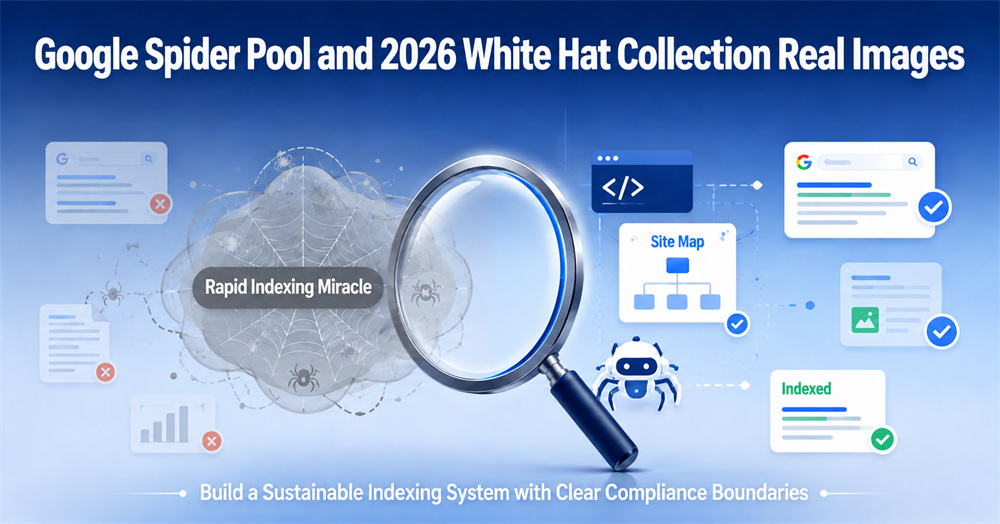
After a new site goes live, most webmasters face slow indexing and long indexing cycles. As a result, various "quick indexing" shortcuts have emerged in the market. Among them, "Google Spider Pools" are packaged as a magic tool for instant indexing and authority boosting, attracting many sites to pay and try. However, most users only see a short-term increase in crawl volume, ignoring the underlying rule risks and long-term costs. Clarifying what a Google Spider Pool is and distinguishing the boundary between violating shortcuts and compliant optimization is the prerequisite for a site to achieve proper Google indexing.
1. Debunking the Myth: The Essence and Hidden Risks of Spider Pools
The so-called Google Spider Pool is essentially a site cluster consisting of dozens to hundreds of domains. It forms a dense network of internal and external links to guide Googlebot in bulk to repeatedly crawl target pages, thereby increasing crawl frequency. Such services often claim "full indexing in 7 days" and "rapid authority boosting." But from the perspective of Google's Search Quality Evaluator Guidelines, its core logic belongs to unnatural link building. It is essentially manipulating PBN (Private Blog Network) links to interfere with crawler scheduling, which violates Google's core policies on link schemes.
Looking at actual results, spider pools can indeed increase the crawl frequency of pages in the short term, but crawling does not equal indexing, let alone ranking improvement. Google's indexing system evaluates the quality of crawled pages; crawl signals brought by unnatural links will not translate into ranking weight. On the contrary, the characteristics of PBN links are easily identified by the SpamBrain algorithm, triggering a silent penalty. Industry monitoring data shows that over 62% of sites using third-party spider pool services experienced a drop in keyword rankings within 6 months. Nearly 30% of these sites had some pages de-indexed, and in severe cases, entire sites were completely removed from search results.
A more hidden risk is that the indexing improvement brought by spider pools is often "fake indexing" — a large number of pages are crawled but fail to enter the valid index, making them unable to compete for rankings. Indexing volume appears to rise, but it yields zero traffic value. Once an algorithmic penalty is triggered, the recovery cycle usually takes 4-12 weeks. During this period, site traffic will experience a cliff-like drop, which actually slows down the overall optimization pace. For B2B sites relying on organic traffic, the ROI of such short-term gain/long-term risk operations is far lower than that of compliant white-hat SEO strategies.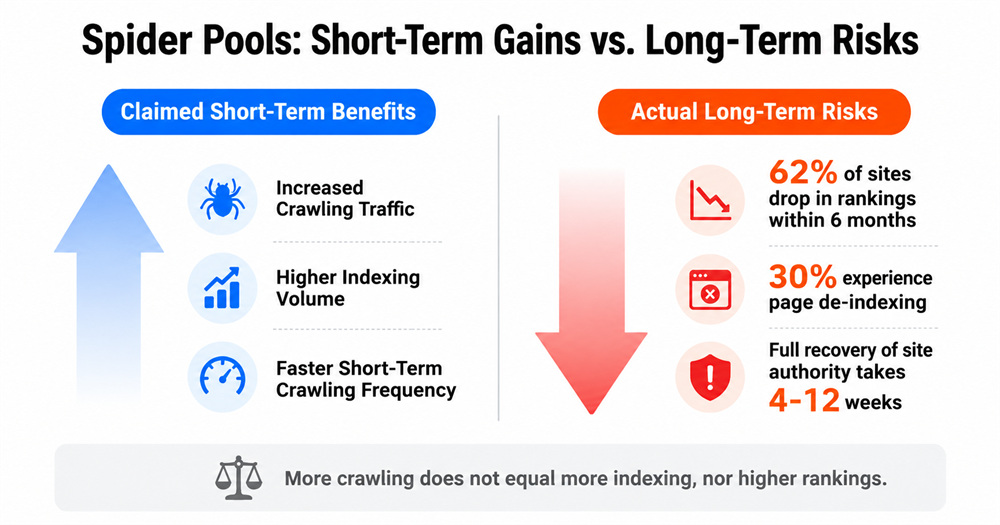
2. White Hat Alternatives: The Core Logic of Compliant Indexing Optimization in 2026
Truly sustainable Google indexing optimization methods are always based on Google's official crawler rules, guiding Googlebot to prioritize crawling by optimizing the site's own signals rather than intervening via external PBNs. The core of 2026 white-hat SEO indexing optimization is to synergistically improve crawl efficiency from three dimensions: technical architecture, link structure, and proactive submission, ensuring high-quality content receives higher crawl priority.
1. Refined Sitemaps: Providing Clear Navigation for Crawlers
XML Sitemaps are the core entry point for Googlebot to discover pages and the most fundamental Google indexing optimization technique. Many sites' sitemaps have redundancy issues, mixing low-value links like pagination parameter pages, filter result pages, and 404 pages, which wastes the crawl budget. The correct approach is to build tiered, precise sitemaps: only include canonical pages that need to be indexed, and categorize them into daily-updated content sitemaps and low-frequency product sitemaps; accurately tag the last modified time of each URL so crawlers can identify content freshness.
After submitting the streamlined sitemap to Google Search Console, the clarity of target pages for crawlers is significantly improved. The proportion of invalid crawls can be reduced by over 30%, and the average crawl cycle for new content is shortened by 40%. This is the foundation of all indexing optimization, and it is also the method with the lowest investment and most stable results.
2. Internal Link Structure Optimization: Passing Crawl Weight
Googlebot's crawl priority is largely determined by the quantity and quality of a page's internal links. "Orphan pages" with no internal links pointing to them are hard for crawlers to discover and will be judged as low value. A reasonable internal link structure follows the "flat" principle: the click depth from the homepage to any content page should not exceed 3 levels; core category pages and high-authority article pages should prioritize linking to newly published content; within 24 hours of publishing new content, deploy 2-3 contextual links from related, already-indexed pages to pass crawl weight.
This method of internal link distribution essentially channels the site's existing authority to new content, allowing crawlers to naturally discover new links when traversing high-authority pages. It aligns with crawl rules and simultaneously boosts the page's ranking weight. Industry testing data shows that sites with robust internal link structures achieve a first-crawl speed for new content that is 2-3 times faster than sites without internal links.
3. Proactive Submission via Indexing API: The Official Fast Track
For time-sensitive content, the Google Indexing API is an officially recognized method to accelerate indexing. Originally designed for time-critical scenarios like job postings and livestream events, its practical application in 2026 is equally effective for high-quality standard content. By configuring a Google Cloud Service account, you can proactively push index requests to Google immediately after content goes live. A single account can submit up to 200 URLs daily, and crawler response times typically range from 15 minutes to 2 hours.
It is important to note that API submission merely notifies crawlers to visit; it does not guarantee indexing. The final outcome still depends on the quality of the page content. Bulk pushing low-quality pages will actually lower the site's trust rating within the crawling system, resulting in decreased crawl priority in the future.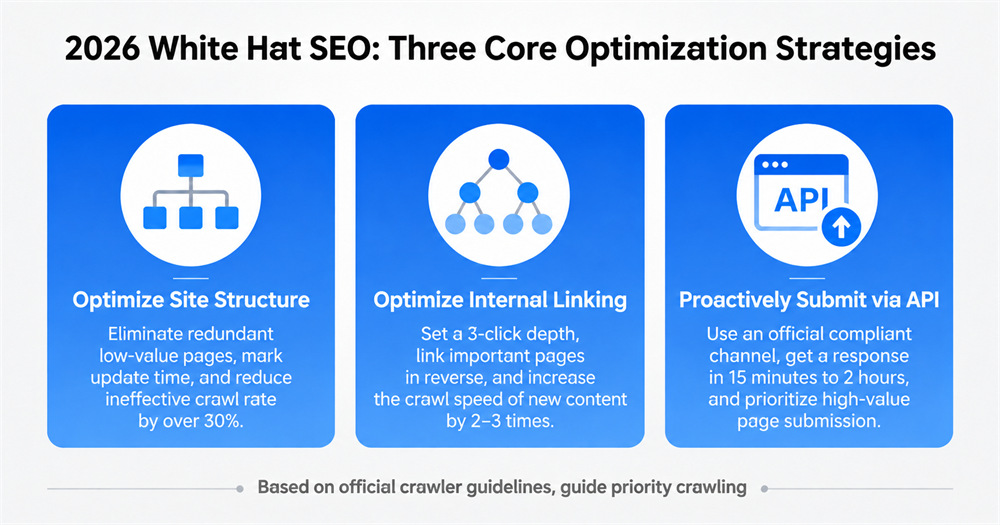
3. Practical Implementation: The Standard Indexing Acceleration Process for New Sites and New Content
Combining the above Googlebot indexing optimization techniques, new site content publishing can follow a standardized five-step process to achieve fast indexing within compliant boundaries. This is also a proven Google indexing acceleration method validated by a large number of foreign trade B2B websites.
Step 1: Pre-launch Technical Audit. Before publishing, ensure the page returns a 200 HTTP status code, robots protocol does not block crawling, the canonical tag points correctly, and the page is free of quality issues like thin content or placeholders. Technical hurdles are the most common cause of slow indexing, with about 40% of indexing delays originating from basic configuration errors.
Step 2: Update the Sitemap. Update your sitemap immediately after content goes live, accurately marking the latest modification time, and resubmit it via Google Search Console to trigger bulk crawler scheduling.
Step 3: Deploy Internal Links. Add 2-3 contextual links pointing to the new content from the homepage, related category pages, or already indexed high-authority articles. Use target keywords as anchor texts to pass on crawl priority.
Step 4: Proactive API Submission. For core content, submit indexing requests via the Google Indexing API. Prioritize pushing high-value pages and avoid blindly bulk-submitting low-quality content.
Step 5: Periodic Review and Optimization. Review the Crawl Stats report in Google Search Console weekly to locate uncrawled or non-indexed pages, identify the root causes, and apply targeted optimizations to continuously improve overall indexing efficiency.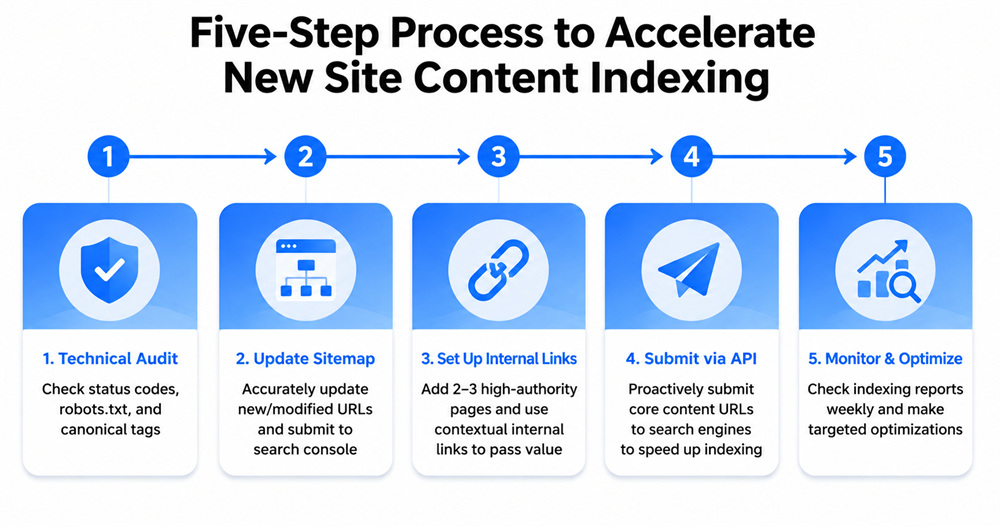
Case Study
A B2B industrial parts website purchased third-party spider pool services for quick indexing during its initial launch. Within two weeks, the site's crawl volume increased by 34%, appearing to show significant indexing growth. However, a month later, core product keyword rankings dropped by an average of 11 positions, 17 product pages were removed from the valid index, and organic traffic actually declined instead of rising.
The site later pivoted to a white-hat SEO strategy. They reorganized their sitemaps, eliminating over 1,200 low-value redundant links; reconstructed their internal linking architecture to establish a three-tier "Homepage - Category Page - Product Page" system; and utilized the Indexing API to push core content. After implementing these optimizations, the average first-crawl time for new content plummeted from 76 hours to 18 hours. Three months later, valid indexed pages surged by 91%, core keyword rankings gradually recovered and even exceeded their previous peak by 19%, and traffic stability improved drastically. This type of full-funnel optimization—from technical architecture to content operations—is exactly the robust path we have repeatedly validated in our long-term digital marketing services for global trade.
The core of SEO optimization techniques in 2026 is no longer about finding shortcuts, but refining operations based on official rules. The essence of schemes like Google Spider Pools is to exploit information gaps to harvest webmasters eager for quick success. Behind the short-term crawl spike lies long-term algorithmic risk. For sites aiming for long-term organic traffic, strictly following white-hat logic and excelling in basic optimizations across three dimensions—sitemaps, internal link structure, and proactive submission—is the only stable and sustainable method for Google indexing optimization. True indexing acceleration never relies on external tool interventions; instead, it earns crawler priority through the site's own quality and structure.