

When a new B2B independent export website goes live, most enterprises face the exact same strategic dilemma: Should you prioritize Google SEO for organic growth, or invest directly in Google Ads? Companies that choose a pure SEO strategy often suffer from a traffic vacuum for the first three months, waiting endlessly for inquiries and ultimately missing critical market windows. Conversely, companies that rely on a pure Ads strategy frequently suffer from wasted budgets and chronically high acquisition costs due to inaccurate keywords and inefficient conversions.
In reality, SEO and Ads are not mutually exclusive. For a newly launched site, each channel offers irreplaceable value. A scientifically integrated approach not only overcomes the slow pace of SEO but also reduces the long-term customer acquisition costs of Ads, making it the optimal path for new websites to achieve a rapid market breakthrough.
Objective Comparison: Core Value Differences Between SEO and Ads
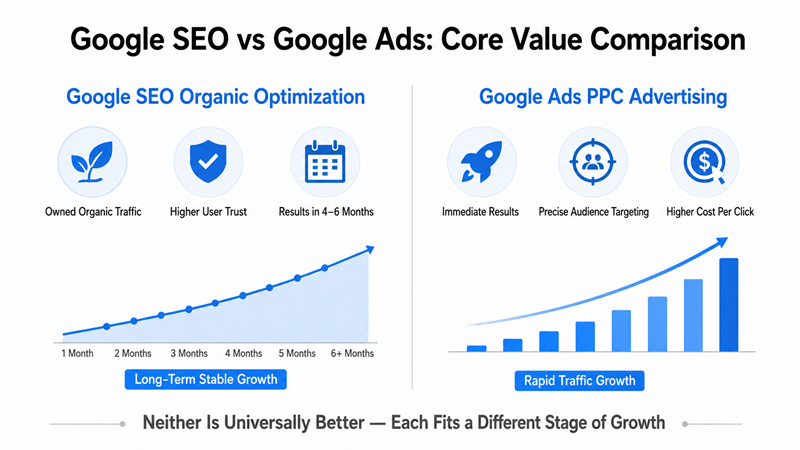
SEO and Ads represent two entirely different traffic acquisition logics within the Google ecosystem. Neither is inherently superior; the difference lies in their adaptability to different business growth stages.
| Dimension | Google SEO (Organic Asset) | Google Ads (Paid Precision) |
| Core Logic | Optimizing content, site architecture, and backlinks to earn free organic ranking. | Pay-per-click (PPC) bidding to instantly occupy top ad spots. |
| Primary Advantage | Strong asset value: Stable rankings generate ongoing free traffic; higher user trust and inquiry quality. | Instant results & high precision: Live in hours; highly targetable by keywords, geography, and demographics. |
| Key Limitation | Long cycle: Takes 4–6 months on average for industrial B2B keywords to reach Page 1. | High cost & zero residue: CPC averages $2.3–$4.5 for B2B industrial goods; traffic stops instantly when spending stops. |
| Early Performance | Contributes < 8% of organic inquiries in the first 3 months. | Can result in > 30% invalid clicks and CPA exceeding $150 if keywords are poorly targeted. |
Why is Pure SEO Too Slow and Pure Ads Too Expensive?
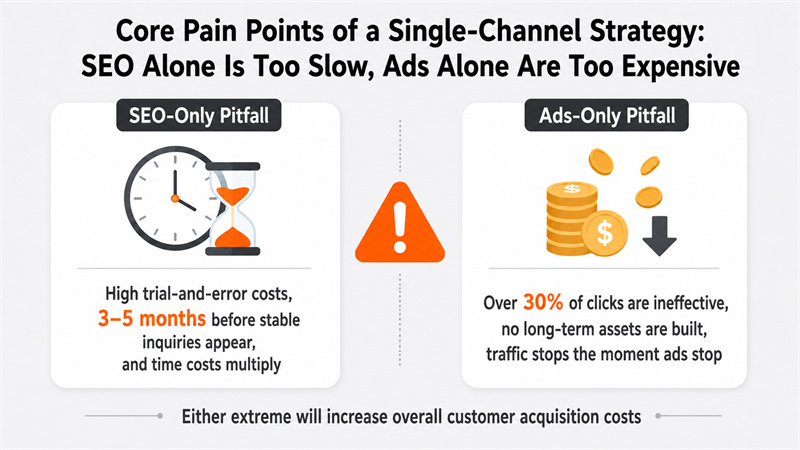
The limitations of relying on a single channel are the root cause of inefficient promotion for new websites. Both extremes force enterprises to pay unnecessary costs.
The "Slowness" of Pure SEO Lies in High Trial-and-Error Costs: A new website lacks initial user data, forcing businesses to guess keyword directions based purely on intuition. Often, after spending 3–5 months optimizing a set of keywords, companies discover they yield low search volumes and poor conversions, forcing a time-consuming pivot. Many manufacturers spend half a year on SEO without generating steady inquiries simply because their initial keyword strategy lacked real-world data validation.
The "Expense" of Pure Ads Stems from Zero Long-Term Asset Accumulation: In the early stages of a website launch, landing page conversion capabilities and keyword precision are still being calibrated. The budget spent in the first 1–2 months is essentially paying to buy market data, leading to high inefficiency. Relying solely on Ads over the long term means facing continuously rising cost-per-click (CPC) rates as industry competition intensifies. More importantly, paid traffic does not build domain authority; the moment your advertising budget is tightened, traffic and inquiries will fall off a cliff.
The 100-Day Breakthrough Strategy: An Integrated SEO + Ads Growth Model
The optimal promotion logic for a new website is "Ads first to test data, SEO following to build assets." Known in the industry as the "using broad reach to guide optimization" model, this strategy leverages Ads to quickly harvest authentic user search and conversion data. This data then feeds into your SEO keyword layout and content strategy, eliminating guesswork while gradually replacing paid traffic with free organic traffic to lower overall customer acquisition costs.
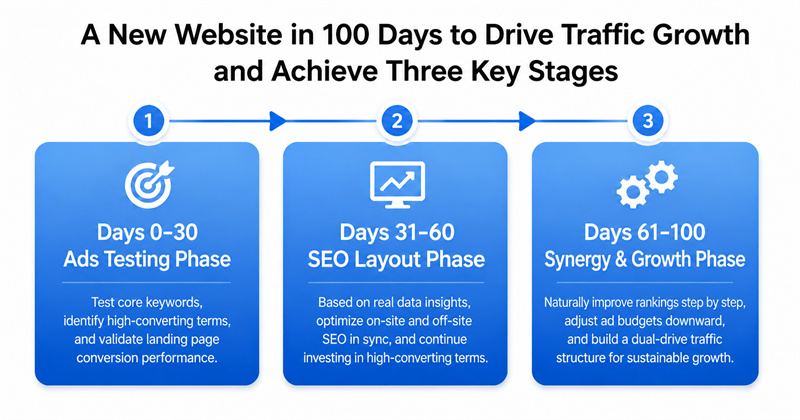
The complete 100-day execution plan is divided into three strategic phases:
Phase 1 (Days 0–30): Ads-First Testing to Lock in High-Converting Keywords
When a new site launches, prioritize Google Ads campaigns. The core objective at this stage is not to generate massive immediate orders, but to rapidly test the market. Select 30–50 core product terms and long-tail keywords to run ads, monitoring three critical data sets:
High-click, high-conversion premium keywords.
Low-efficiency keywords that generate clicks but zero conversions.
Authentic user search queries (Search Terms Report).
Simultaneously, use this traffic to validate landing page performance. Optimize page content and form designs based on user dwell time, bounce rates, and inquiry submission rates. Within roughly 30 days, you can filter out 15–25 genuinely high-converting keywords, providing a highly precise roadmap for your upcoming SEO efforts.
Phase 2 (Days 31–60): Synchronized SEO Deployment to Capture Quality Traffic
Using the high-converting keywords identified in Phase 1, initiate your SEO campaign.
On-page optimization: Embed these proven keywords into the titles, body text, and anchor text of your product and blog/news pages, creating authoritative, professional content around these specific topics.
Off-page optimization: Build high-quality, relevant backlinks around your core search terms to steadily increase domain authority.
During this phase, keep your Google Ads campaigns running, but gradually pause underperforming keywords. Reallocate your budget to top-converting terms. This maintains a steady volume of incoming inquiries while buying essential time for your SEO rankings to climb.
Phase 3 (Days 61–100): Dual-Engine Synergy for Sustainable Cost Reduction
By the third month of operation, organic rankings for several long-tail keywords will begin entering the first two pages of Google, and organic traffic will start contributing a stable flow of inquiries. At this point, you can systematically scale down your Google Ads budget and shift your primary operational focus to deep SEO optimization and capturing broader mid-to-long-tail keyword rankings.
Ultimately, you will build a dual-engine traffic structure: Google Ads captures high-volume core keywords for precision scaling, while Google SEO blankets long-tail keywords for sustainable asset accumulation. Industry data reveals that new websites adopting this integrated approach achieve a cost per effective inquiry within 100 days that is over 40% lower than those using pure Google Ads—with acquisition costs continuing to drop as SEO authority matures.
Xiamen First Page: An All-in-One Closed-Loop Solution
As an 11-year Google Premier Partner, Xiamen First Page brings 20 years of digital marketing experience in foreign trade, having served over 10,000 B2B export enterprises. To solve the specific growth pain points of newly launched websites, we have developed an all-in-one full-service solution: "Website Development + Ads Management + SEO Optimization."
We build SEO-ready underlying architecture directly into the development phase. Furthermore, our Ads management and SEO teams operate with seamless data sharing and collaborative workflows. This truly executes the integrated growth logic without the inefficiencies and data silos associated with managing multiple disjointed vendor teams.
In practice, our team tailors a 100-day integrated promotion plan based on your specific product category, target market, and budget:
Website Building: Pre-installing essential SEO technical configurations to ensure absolute compliance with Google's indexing rules.
Post-Launch: Our Ads team rapidly launches test campaigns to output real-time keyword conversion data.
Optimization: Our SEO team utilizes this verified data to perform targeted optimization, achieving a frictionless transition between paid advertising and organic search traffic.
Real-World Case Study: Fujian Industrial Valve Manufacturer
A Fujian-based industrial valve enterprise initially managed its own Google Ads upon launching a new independent website. With a monthly budget of 8,000 RMB, they averaged only 7 effective inquiries per month—yielding a staggering cost-per-inquiry exceeding 1,100 RMB, with zero organic traffic accumulation.
After partnering with Xiamen First Page, our team deployed the integrated full-service strategy:
First 30 Days: Leveraged Google Ads testing to uncover 28 high-converting long-tail keywords while simultaneously restructuring the on-page SEO architecture and product detail pages.
By Day 60: 12 long-tail keywords successfully ranked on Google’s first page. The Ads budget was aggressively shifted toward top-performing words, reducing wasted ad spend by 35%.
By Day 90: The website’s organic traffic share rose to 32%, the cost per effective inquiry dropped by 47%, and average monthly effective inquiries surged to 19. The client successfully achieved both rapid customer acquisition and long-term digital traffic asset accumulation.
Promoting a new B2B export website is never an "either/or" choice between SEO and Ads. You rely on Ads in the short term for rapid breakthroughs and data validation, while leveraging SEO in the long term to accumulate digital assets and drive down costs. Only through their synergy can an enterprise achieve both efficiency and profitability. With our full-funnel service capabilities, Xiamen First Page empowers new export websites to bypass costly trial-and-error stages, achieving rapid traffic growth within 100 days and long-term, sustainable expansion.