

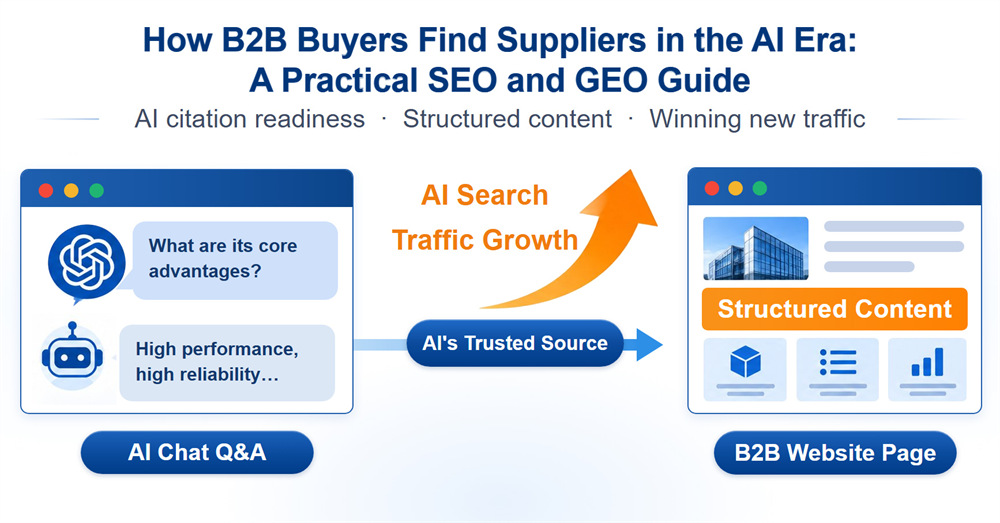
With the rise of generative AI, the way overseas buyers gather information has fundamentally changed. More and more B2B buyers first use AI tools to look up product information and shortlist suppliers, then turn to Google to verify the details and visit standalone sites. This shift is pushing Google's algorithm toward generative experiences, and the core direction of Google SEO updates has expanded from traditional search rankings to AI citation weight. For B2B export standalone sites, traditional SEO alone no longer covers every traffic entry point. Mastering Generative Engine Optimization (GEO) so that your content is reliably cited by AI Overviews and ChatGPT is becoming the new key to traffic growth.
According to a user behavior survey of nearly 100 foreign trade B2B clients conducted by Xiamen First Page, 63% of industrial buyers in North America and Europe now prioritize generative AI during the procurement research stage to get basic information such as product selection, industry standards, and price ranges. Only 37% start from scratch with a Google search. This means that if your standalone site cannot be cited by AI as a trusted source, you will miss the first stage of buyer outreach and lose a large number of potential customers.
1. Content Preferences in AI Search: Structured, Definitive, and Verifiable
Key takeaway: Generative engines cite content based on a simple logic: low extraction cost and high factual credibility. Pages with a clear structure, standardized markup, and explicit facts are far more likely to be cited by AI than long, essay-style content. AI Overviews and ChatGPT each have their own emphasis, but their underlying standards align closely with the E-E-A-T principles.
Many practitioners are unsure how to get their content cited by ChatGPT or how to optimize for AI Overviews. In essence, the question comes down to understanding how AI filters information. Unlike a search engine, which crawls pages and ranks them by authority, a generative AI has to extract accurate facts from pages and assemble them into a coherent answer for the user. As a result, AI prioritizes pages that are cheap to extract from, highly accurate, and authoritative.
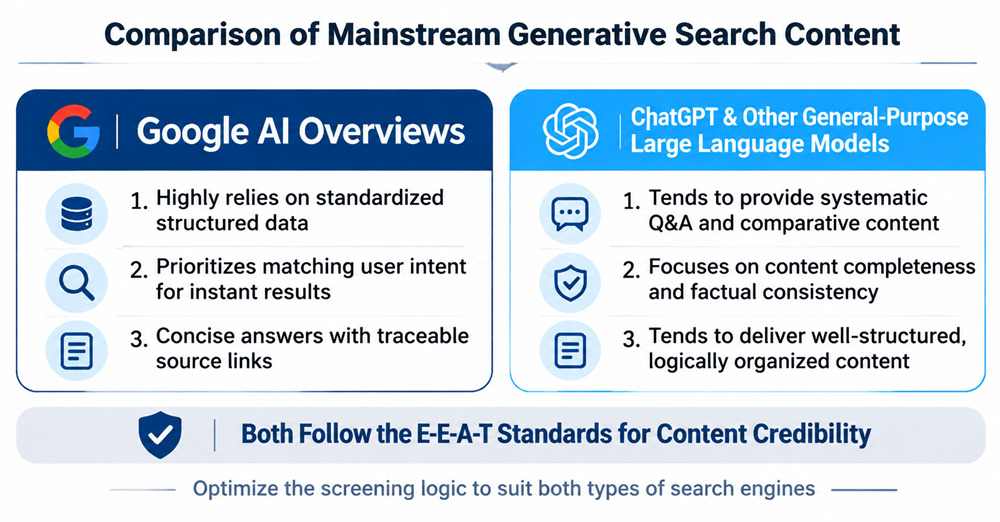
The two mainstream generative search scenarios differ slightly in their preferences:
Google AI Overviews: These rely heavily on official standardized page markup and structured data. They prioritize factual content that complies with Google's guidelines, focus on matching the user's immediate search intent, and tend to give concise answers with traceable sources. The optimization logic is fully aligned with the direction of Google's algorithm and Google SEO updates, making it an extension of traditional SEO into the generative era.
ChatGPT and other general-purpose LLM search: These place more weight on content completeness, multi-dimensional coverage, and factual consistency. They favor systematic Q&A, specification, and comparison content, and tend to adopt whole content blocks with complete logic when citing. They are somewhat more tolerant of imperfect page formatting, but they still prioritize highly structured information.
Whichever type of AI search you target, the underlying evaluation criteria follow the E-E-A-T principles: content with greater expertise, authority, and trustworthiness is cited first. This also means GEO is not a shortcut or a trick. It builds on traditional SEO by further strengthening the structure and certainty of your content so that it fits the way AI reads information.
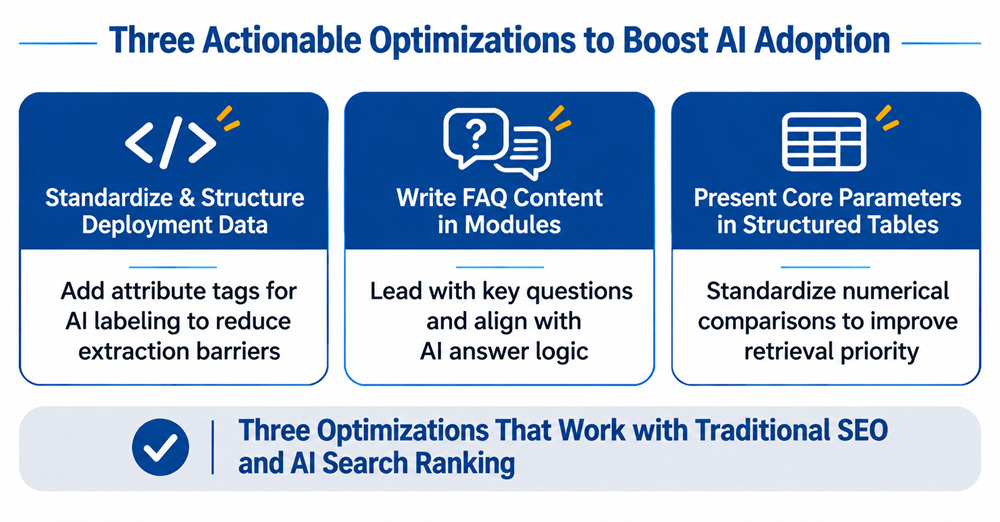
2. Three Actionable Optimizations to Increase AI Citation Rates and AI Search Rankings
2.1 Deploy Structured Data Properly to Lower the Barrier to AI Extraction
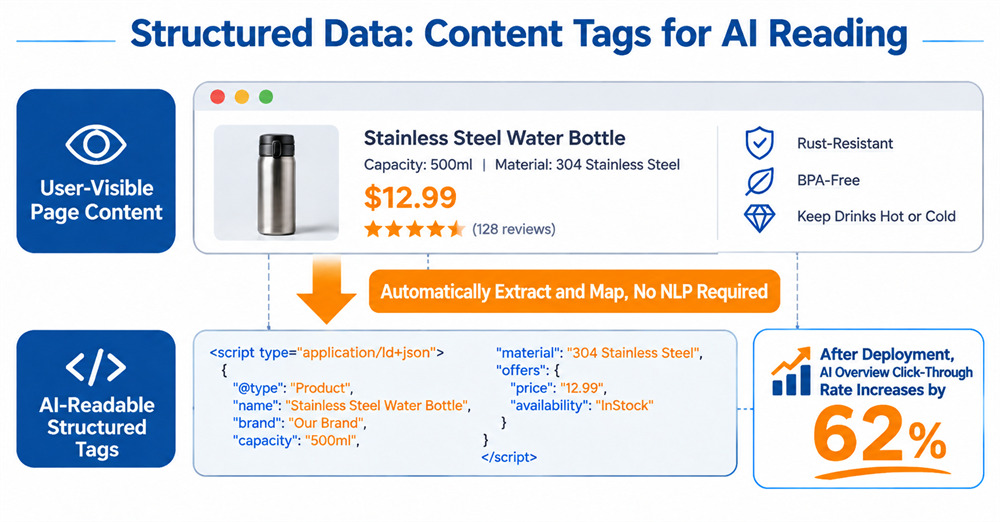
Key takeaway: Structured data works like content labels for AI to read. Deploying it properly greatly reduces the cost of information extraction. It is the core answer to the question of how to write structured data, and it is the foundational step in optimizing for AI Overviews.
Structured data (Schema) uses standardized code tags to tell search engines and AI what each piece of content on a page is: which text is the product name, which are the specifications, which are Q&As, and which is company information. AI no longer has to identify and extract facts from long passages of text. It can retrieve precise factual data directly, which significantly raises the priority of being cited.
Practical Implementation Standards
1. Cover all core pages with the right Schema types: Product pages must carry Product structured data with complete core fields, including product name, model, material, specifications, MOQ, place of origin, and lead time. Do not fill in only the required fields: the more complete the fields, the higher the chance that AI will extract and cite them. Deploy FAQ structured data on FAQ sections, with each question matched one-to-one with its answer. Deploy Organization structured data on company information pages, completing details such as business credentials, contact information, and address.
2. Keep the data strictly consistent with the page content: All information in the structured data must exactly match what is visible on the page. Never misstate specifications or exaggerate claims. False markup not only lowers the trust AI places in your content but also violates Google's search guidelines, which hurts traditional search rankings and runs counter to the core requirements of Google's algorithm.
3. Validate with official tools: After deployment, use Google's official Rich Results Test to confirm there are no errors or missing fields.
According to Xiamen First Page's service sample data, foreign trade sites that fully deployed both Product and FAQ structured data saw a 62% increase in the rate at which Google AI Overviews crawled them and cited them as a source, and a 47% increase in how often ChatGPT cited their content as a trusted source. The corresponding pages' AI search rankings improved by an average of 7 to 10 positions.
2.2 Use a Paragraph-Style FAQ Format to Match How AI Answers Questions
Key takeaway: Writing SEO content in a FAQ style, with the question first, the conclusion immediately after, and the details in separate paragraphs, greatly improves how well your content matches user questions. It is the core optimization direction for getting content cited by ChatGPT, and it also improves traditional long-tail keyword rankings at the same time.
Generative AI naturally answers in a question-and-answer pattern: a user asks a question, and the AI searches pages for the corresponding answer and assembles a complete response. With long, unstructured prose, AI struggles to pinpoint the useful information, so it will not prioritize citing it. With clearly structured Q&A content, AI can extract the answer to a given question directly, at very low citation cost.
Practical Implementation Standards
1. Lead with the core question and put the conclusion first: Open each content section with the real question users ask, follow immediately with a clear conclusion, and then expand on the details and supporting evidence. For example, use “What is the pressure rating of an industrial valve?” as a subheading, give the numerical answer in the first sentence, and then add applicable scenarios, testing standards, and other information, rather than building up background before working toward the answer.
2. Standardize the FAQ module layout: Add a FAQ section at the end of every product page and blog post. Use an H3 tag for each question and place the answer directly beneath it, keeping each answer to 2-3 sentences. Phrase questions the way users actually search, using full questions rather than shortened noun phrases.
3. Cover related questions across multiple dimensions: Add surrounding questions around the core topic, such as product specifications, selection, installation, and after-sales service, to build a complete question matrix. The broader your content coverage, the more likely ChatGPT is to cite it when answering different questions.
Xiamen First Page's controlled test data shows that blog content written in a paragraph-style FAQ structure is 2.3 times more likely to be cited by AI as an answer source than ordinary prose content. The share of AI search traffic to the corresponding pages rose by 35%, and their long-tail keyword rankings in traditional search improved as well.
2.3 Present Core Specifications in Tables to Increase AI's Trust in Your Data
Key takeaway: When numerical and comparative information is presented in tables, AI extracts it more accurately and gives it far higher trust priority than text scattered across paragraphs. This is especially well suited to product specifications and selection comparisons on B2B export sites, and it can effectively improve AI search rankings.
In B2B procurement, a large share of buyer questions revolve around product specifications, side-by-side comparisons, and performance metrics. When AI extracts this kind of data, a well-organized table requires no semantic interpretation or data splitting, so it can pull structured numerical information directly, which gives it the highest citation priority. Tabular content is also more factual, which better meets the credibility requirements of E-E-A-T.
Practical Implementation Standards
1. Put core product specifications in a standard table: Organize the core specifications of every product page into a standard two-dimensional table and place it prominently in the product introduction. Use clear column headers and concise cell content, and avoid cramming long passages of text into cells. Typical dimensions include product model, external dimensions, core materials, operating parameters, applicable environments, MOQ, and lead time.
2. Prefer tables for comparison content: For product selection comparisons, pros-and-cons analyses between solutions, and differences between models, use side-by-side comparison tables instead of descriptive paragraphs. Clearly label the comparison dimensions in the table so that AI can extract the comparison results directly and generate comparison-style answers.
3. Add data notes to reinforce authority: Below each table, add the testing standards, applicable scenarios, and source notes for the data to strengthen the content's professionalism and credibility. This detail is consistent with the E-E-A-T principles and also raises the trust AI places in your data, making it more willing to cite your page as an authoritative source.
Based on optimization results for Xiamen First Page's industrial-sector clients, after specifications were converted to tables, AI search rankings for the corresponding specification-related questions improved by an average of 8 positions, the frequency of being cited by AI as an authoritative specification source rose by 71%, and the share of users clicking through from AI answers to the site also increased significantly.
3. Core Principles and Common Pitfalls of GEO
Key takeaway: GEO is an upgrade to traditional SEO, not a replacement for it. No optimization effort should stray from the foundational rules of Google's algorithm or violate the principle of content authenticity, which has been the consistent core direction of Google SEO updates.
When putting optimization into practice, avoid these three common pitfalls:
First, do not stuff keywords or fabricate data to suit AI. AI's ability to verify factual accuracy keeps improving. False or exaggerated information will lower the trust AI places in your content and may even get it excluded from citation sources. It also violates Google's search guidelines and damages your traditional SEO rankings.
Second, do not neglect traditional SEO fundamentals and focus on GEO alone. A prerequisite for AI citation is that the page is indexed by search engines and has baseline authority. Without the indexing, authority, and backlink foundation built by traditional SEO, a page cannot even enter AI's candidate pool, let alone be cited.
Third, do not over-focus on tactics at the expense of content value. The essence of GEO is lowering AI's extraction cost, but the core is still the value of the content itself. Professional, accurate, and genuinely useful content, even with a somewhat weaker structure, is far more likely to be cited by AI than a page that is perfectly structured but empty.
As Google's algorithm continues to evolve, the focus of Google SEO updates is shifting steadily toward the generative search experience, and GEO has gone from optional to essential for foreign trade standalone sites. By understanding how to write structured data, mastering SEO content creation methods that fit AI logic, knowing how to get your content cited by ChatGPT, and being clear on how to optimize for AI Overviews, you can capture the first wave of traffic in the new buyer journey of “ask AI first, search Google second.”
As a Google Partner recognized for excellence for 11 consecutive years, Xiamen First Page brings 20 years of foreign trade digital marketing experience and has served more than 10,000 export companies. We closely track the latest trends in Google's algorithm and AI search, and we integrate GEO into every stage of our standalone site SEO services, from structured data deployment and content structure optimization to improving AI search rankings. We help foreign trade standalone sites adapt to the traffic rules of the generative search era and consistently win high-quality overseas inquiries. Call or message us on WeChat at 18855144825.