

The technical structure lays the foundation of SEO for export-focused multilingual websites. Wrong structural choices will render subsequent content optimization and promotion investments inefficient. Official Google data shows over 60% of multilingual foreign trade sites suffer structural defects, resulting in indexed page rates below 40%, misplaced keyword rankings and substantial losses of traffic & orders from non-English markets.
Based on official Google SEO guidelines and real-world industry statistics, this article compares the pros and cons of two mainstream site structures (subdomain vs subdirectory) and specifies proper Hreflang configuration to help foreign trade businesses make informed technical decisions.
1. Subdirectory Structure: Top Pick for 90% of Export Enterprises
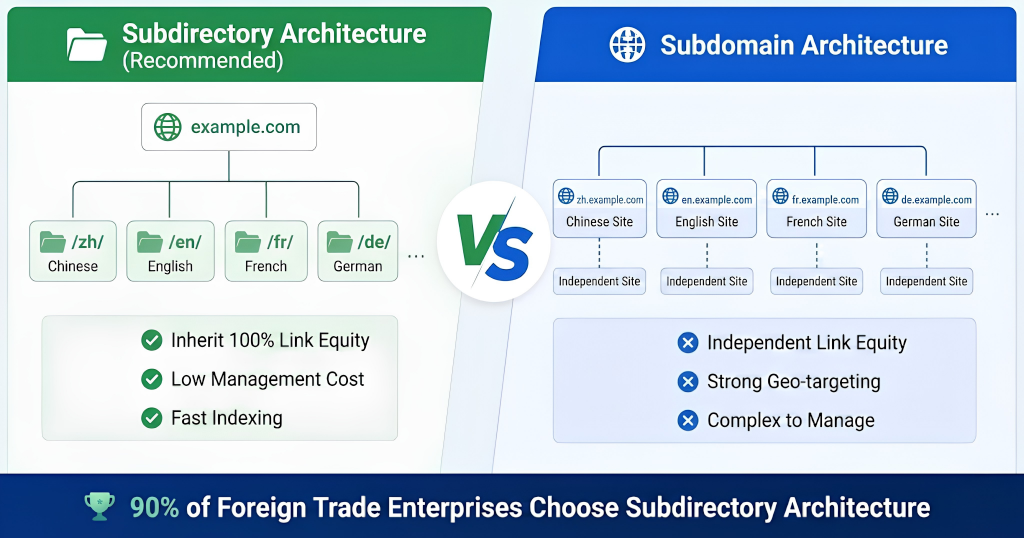
A subdirectory structure stores language-specific content under folders within the root domain, e.g. example.com/es/ for Spanish and example.com/fr/ for French. This is Google’s officially recommended default setup adopted by most export companies globally.
Core Advantages
Full domain authority inheritance: All localized language folders share the root domain’s accumulated backlink profile and trust signals. Research from SE Ranking proves subdirectory pages rank 3 to 5 times faster on average than subdomain counterparts.
Lowest maintenance cost: No extra domain purchases, independent DNS or SSL setup required; all language editions are managed from one backend, cutting content update & maintenance workload by over 60%.
Superior crawl efficiency: Googlebot crawls only a single root domain to discover all localized pages, eliminating the need for split crawl budget allocation across separate subdomains.
Drawbacks
Weak geographic targeting signals; Hreflang tags are mandatory to serve correct regional visitors precisely.
Limited flexibility for fully independent regional market operation.
Best-fit Scenarios
Most small and medium-sized foreign trade manufacturers
Brands expanding into multiple emerging markets concurrently
Companies aiming for fast ranking improvement and organic traffic growth
Budget-conscious businesses looking to control technical overhead
Case Study: An electronics parts manufacturer based in Ningbo migrated five standalone language subdomains to a unified subdirectory setup in 2024.
Within six months, total organic traffic rose by 128%, while core keywords landing on Google’s first page climbed from 21% to 57%.
2. Subdomain Structure: Deep Localization Option for Large Corporations
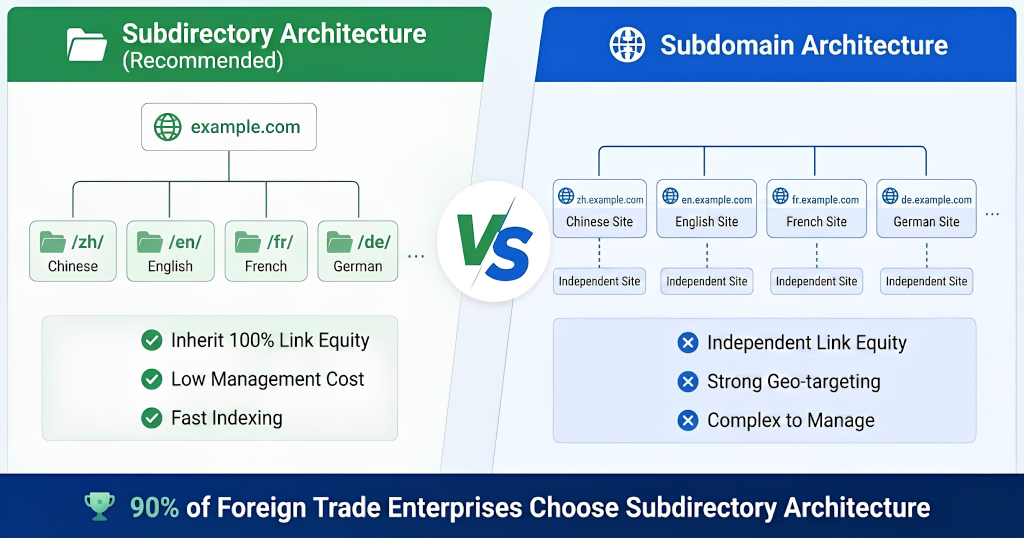
Subdomain structure creates independent second-level domains per language, such as es.example.com (Spanish) and fr.example.com (French). Google treats each subdomain as a semi-independent website with minimal authority passed down from the root domain.
Core Advantages
Robust geo-targeting: Each subdomain can be assigned target countries individually inside Google Search Console, ideal for markets requiring in-depth localization.
Fully independent operation: Separate design frameworks, product catalogs and marketing strategies can be deployed per region, matching multinationals with overseas subsidiaries.
Regulatory compliance support: For jurisdictions like Germany and France enforcing local data hosting laws, subdomains simplify physically separated server deployment.
Drawbacks
Zero inherited authority: Every subdomain needs independent backlink building and SEO tuning, costing 2 to 3 times more than subdirectory management.
Slow indexing: New subdomains normally take 3–6 months to earn basic Google trust, leading to extended ranking timelines.
High management complexity: Multiple standalone site backends raise risks of unsynchronized content and version confusion.
Best-fit Scenarios
Large multinational groups
Enterprises with local subsidiaries and dedicated operation teams in target nations
Regions mandating strict local data storage compliance
Well-funded firms capable of running multiple independent websites
Case Study: A German auto component supplier deployed a standalone Chinese-market subdomain with localized server hosting and tailored content, lifting conversion rates for China traffic by 22% against its generic global English site.
3. Hreflang Tags: The Unique ID of Multilingual Websites
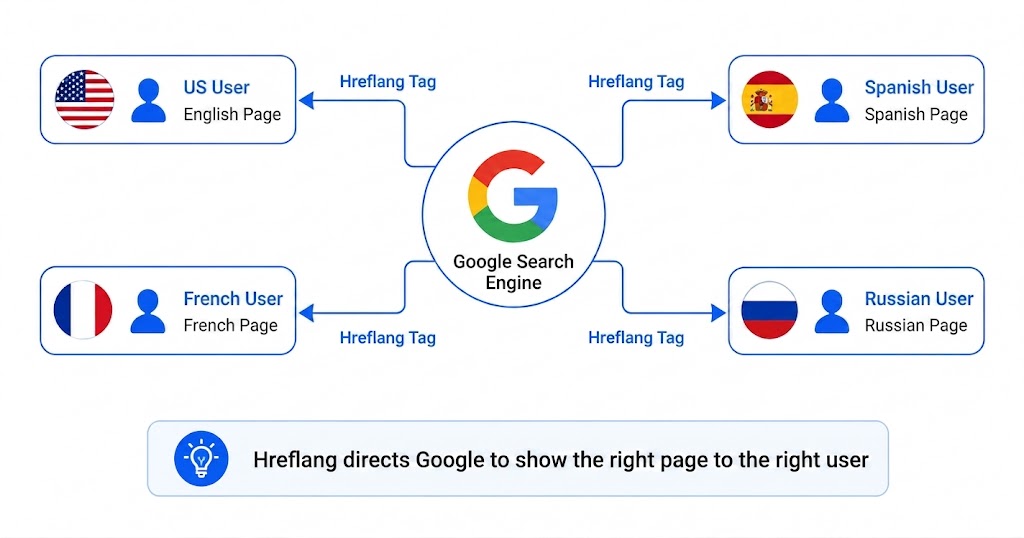
Hreflang markup is compulsory regardless of subdirectory or subdomain architecture. It is Google’s exclusive approved markup to map regional & linguistic page relationships. Missing or faulty Hreflang causes duplicate content penalties, wrong page ranking and poor indexing.
Core Functions
Inform Google of cross-language page correspondences.
Deliver region-specific language pages to matching international visitors.
Prevent Google from flagging similar translated content as duplicates to avoid ranking downgrades.
Official Configuration Rules
Follow BCP47 international coding standard in format language-region, e.g., es-ES for Spanish in Spain, es-MX for Mexican Spanish.
Reciprocal linking: Page A links to Page B, and Page B must link back to Page A to form a full closed loop across all alternate versions.
Mandatory self-referencing: Every page must include an Hreflang tag pointing to its own URL.
Use absolute URLs instead of relative paths for reliable Google identification.
Common Configuration Mistakes
Hreflang only added on English pages without reciprocal tags on alternate language pages.
Incorrect language or country code inputs.
Tags directing to non-existent or 404 error pages.
Excessive Hreflang entries slowing down webpage loading speed.
4. Customized Recommendations & Solutions from Xiamen First Page
For most export merchants, combining subdirectory architecture with properly set Hreflang tags delivers the highest ROI. This setup maximizes root domain authority to penetrate multiple markets cost-effectively; subdomains are only recommended for brands needing deep standalone localization in specific territories.
As an 11-year consecutive Google Premier Partner, Xiamen First Page owns 20 years of digital export marketing experience with over ten thousand served global clients. Our self-developed multilingual site system defaults to Google-preferred subdirectory structure with auto-generated compliant Hreflang code, eliminating common manual configuration errors.
Our in-house technical team designs customized structural blueprints based on clients’ product lines and target territories. Our 249-language website development service helps enterprises cover nearly all global regions while safeguarding consistent SEO performance across all localized editions.
Case Study: A premium door & window exporter headquartered in Shanghai partnered with First Page to build a subdirectory-based multilingual site covering six languages including English, Spanish, French and Russian. Auto-generated Hreflang markup enabled flawless Google page identification. Over 10 months, the site earned rankings for 9,736 organic keywords, nearly 3,000 of which secured positions within Google’s top two pages, driving a 217% surge in total organic traffic.
Selecting multilingual site architecture is a long-term strategic decision that shapes overseas lead generation for the next 3–5 years. Businesses shall finalize structures matching their scale, budget and global layout, paired with standardized Google-compliant Hreflang implementation.
Xiamen First Page provides end-to-end services spanning multilingual site construction, structural SEO optimization and ongoing search promotion, helping exporters bypass technical pitfalls and unlock revenue potential across global non-English markets with controlled investment.