

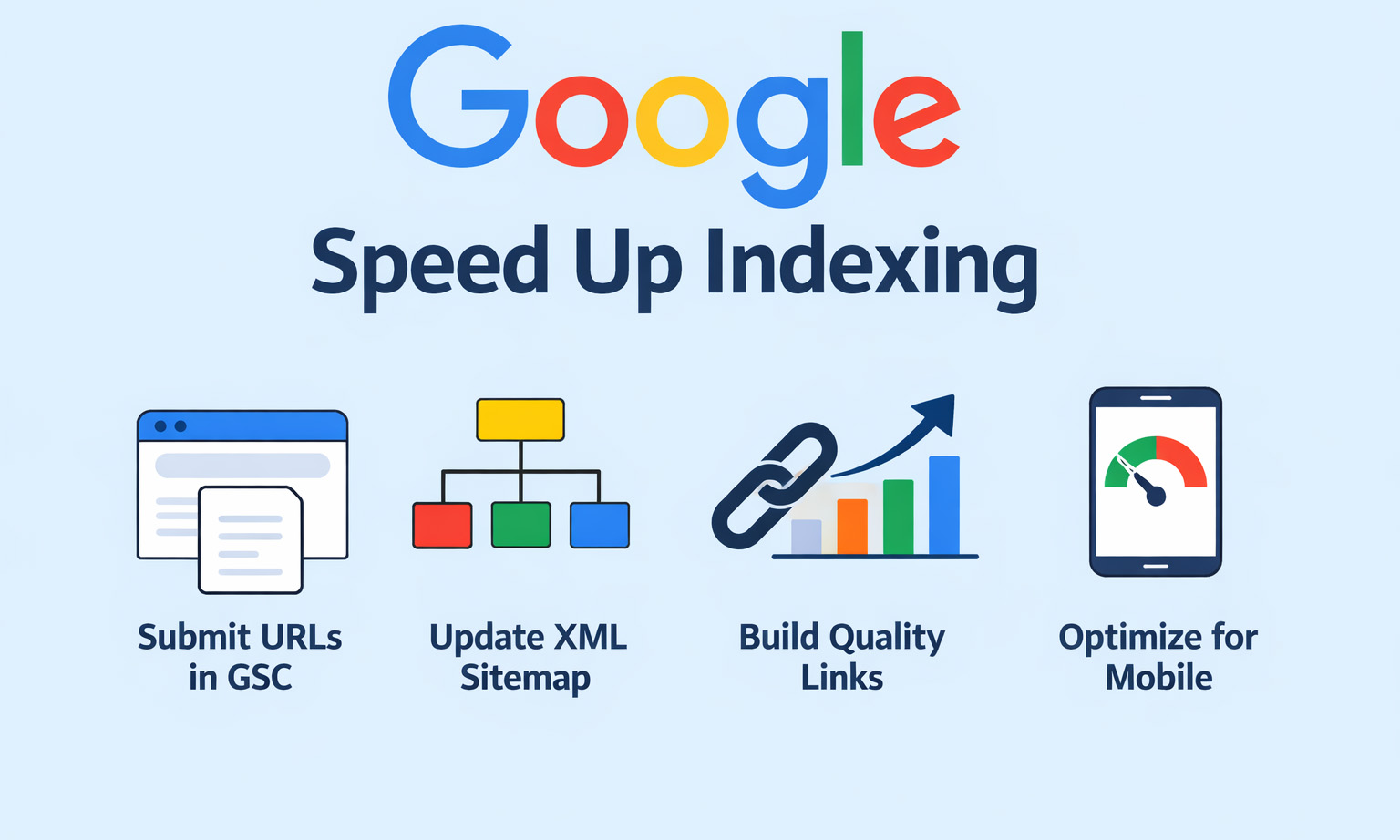
For foreign trade independent websites, Google indexing is the first step to getting organic traffic. No matter how good your content is, if Googlebot doesn’t crawl or index your pages in time, your site will struggle to gain visibility in search results—let alone generate inquiries and conversions.
As Xiamen First Page Company, with years of deep expertise in foreign trade marketing, we are often asked the same question by clients:
“Why has my new website been online for a month but still isn’t indexed by Google?”
Entering 2026, Google has raised its standards for technical compliance, content quality, and user experience signals. To help foreign trade website owners break through faster, we’ve compiled 12 verified and effective methods to help you promote your website on Google more efficiently.
12 Solutions for Slow Google Indexing
1. Manually Submit URLs via Google Search Console (GSC)
This is the most direct and fastest way to see results.
Log in to GSC and use “URL Inspection” to enter the new page URL:
If it shows “URL is not on Google”, click “Request Indexing”
Best for: newly published core pages, key product pages, and important blog articles.
It’s recommended to prioritize submitting: Homepage / core category pages / key product pages / high-quality articles
(Do not submit a large number of low-quality pages at once.)
2. Submit and Continuously Update Your XML Sitemap
A sitemap is essentially a “directory” for Google. Make sure your site automatically generates an XML sitemap and submit it to GSC.
Whenever you add products in bulk or update a large amount of content, updating the sitemap helps Google rediscover pages faster.
3. Use API Auto-Push for Large Websites (Best for B2B Sites with Many Products)
If your website has thousands of pages, manual submission is not realistic. Consider using an API to automatically push URLs so Google can discover new links faster.
Applicable scenarios:
B2B independent websites with many SKUs
Websites that update news/blog content frequently
Note: Indexing API is officially designed for specific content types. In actual use, you should evaluate based on your website’s nature and avoid misunderstanding that “pushing = guaranteed indexing.”
4. Build High-Quality Internal Links So Googlebot Can “Reach” the Page
Googlebot crawls by following links. If a new page has no internal entry links, Google may not even discover it.
Recommended actions:
Link new pages from the homepage, popular category pages, or best-selling product pages
Naturally link blog posts to products and category pages
Add “Recommended Products / Related Articles” modules on category pages
A strong internal linking structure often significantly improves crawl frequency and indexing speed.
5. Fix 404 Errors and Redirect Chains to Save Crawl Budget
Too many 404 errors and complex redirect chains waste Google’s crawl resources (crawl budget).
Suggestions:
Regularly scan and fix broken links (404)
Keep 301 redirects “one-step” whenever possible—avoid chained redirects
Remove meaningless parameter URLs and duplicate pages
6. Improve Server Response Speed So Crawlers Can “Enter and Move Faster”
If overseas loading speed is slow or TTFB is too high, Googlebot may crawl less efficiently—or even give up.
Suggestions:
Enable a CDN (such as Cloudflare)
Use stable overseas hosting/server nodes
Convert images to WebP and enable caching and compression
In real projects, Xiamen First Page Company has found that speed optimization affects not only indexing, but also future rankings and conversions.
7. Deploy Structured Data (Schema Markup) to Improve Page Understanding
Schema helps Google understand your page content and page type faster. For foreign trade sites, prioritize:
Product (product pages)
Article (blog posts)
FAQ (frequently asked questions)
Breadcrumb (breadcrumb navigation)
Structured data doesn’t guarantee “instant indexing,” but it improves understanding efficiency and increases the chances of rich results.
8. Maintain a Consistent Update Frequency to Build Crawling Habits
Websites that remain inactive for a long time may receive fewer visits from Google.
Suggestions:
Publish 1–2 high-quality articles per week (especially important in the early stage)
Regularly add new products and improve product descriptions
Avoid low-quality “copy-paste” updates
9. Create “Discovery Signals” Through Social Media and External Channels
Share new pages on: LinkedIn / Facebook / X (Twitter) / Pinterest, etc.
Even though most social media links are nofollow, they can:
Bring real traffic
Trigger discovery signals
Create opportunities for natural backlinks
For new websites, this is a low-cost and highly practical step.
10. Acquire High-Quality Backlinks to Shorten the “Observation Period” for New Sites
A backlink from an authoritative industry website is like a “trust vote” for Google.
This is one of the most critical—and most difficult—parts of professional Website SEO Service.
Backlink priorities:
Industry media and resource pages
High-quality guest posts
Real business collaboration references
Niche directories and associations (which provide trust signals)
Important: Do not spam low-quality backlinks. It may create “short-term movement,” but it will seriously damage your site long-term.
11. Check robots.txt and noindex to Avoid Technical Mistakes
Many cases of “slow indexing” are actually caused by blocking indexing directly.
Check the following:
Whether robots.txt incorrectly includes Disallow
Whether pages contain meta robots noindex
Whether your CMS/plugins have hidden restrictions
This must be the first step when diagnosing indexing issues.
12. Optimize Mobile Experience and Core Web Vitals (Key Metrics in the Mobile-First Era)
Google uses mobile-first indexing. If your site has:
Poor mobile layout
Laggy interactions
Slow loading speed (poor Core Web Vitals)
Google may lower crawl priority, impacting indexing and rankings.
Make sure you pass: Mobile-Friendly Test + Core performance metrics reaching basic standards.
Why Choose a Professional Foreign Trade SEO Service?
SEO has never been as simple as “just publishing articles.” It is a systematic project driven by technology, content, links, structure, and user experience.
Many foreign trade website owners face indexing obstacles because they make mistakes in technical details or content strategy, which prevents Google from crawling efficiently—or makes Google unwilling to index the site.
With 20 years of foreign trade promotion experience, Xiamen First Page Company provides full-process Website SEO Service, including:
Technical SEO (crawl/indexing/speed/structure)
Content planning and keyword strategy (aligned with overseas search intent)
High-quality backlinks and brand signal building
A closed-loop growth system from indexing → ranking → inquiry conversion
We not only help businesses promote websites on Google faster, but also focus on generating high-quality inquiries and sustainable growth through accurate keyword rankings.