
Deploying multilingual independent websites has become a core strategy for many foreign trade enterprises to expand into incremental markets. However, many foreign trade managers share a persistent core concern: while their websites can drive traffic, their teams lack full-time multilingual sales staff, leaving them unable to handle incoming inquiries professionally and resulting in avoidable order losses. For this reason, many enterprises hesitate to invest in non-English markets and miss out on blue ocean opportunities.
In fact, language is not an insurmountable barrier in B2B foreign trade scenarios. The communication characteristics of B2B procurement, mature AI tools, and systematic website design can fully compensate for sales staff’s limited multilingual proficiency, enabling efficient reception and conversion of traffic.
1. Correcting Misconceptions: Language Barriers Are Far Lower Than Expected in B2B Scenarios
Most enterprises’ concerns about multilingual communication stem from cognitive inertia formed by C-end daily interactions, yet the language environment for B2B industrial procurement is fundamentally different.
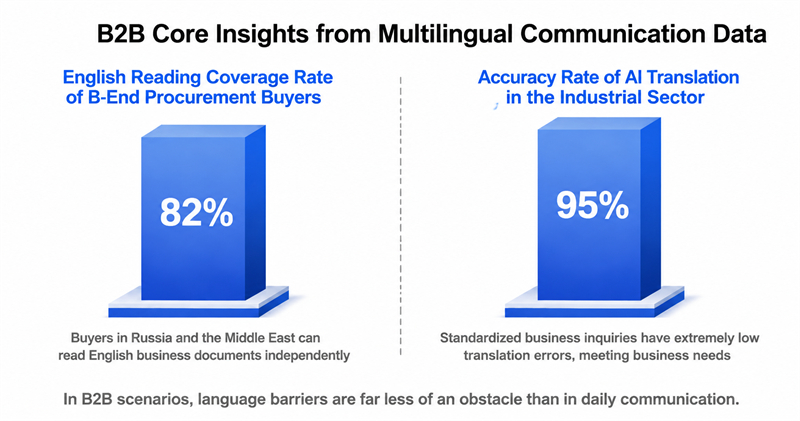
First, B2B procurement personnel generally have solid business English reading and writing skills. In vertical sectors such as machinery, industrial products and hardware, globally accepted industry standards, technical parameters and product manuals mostly use English as the official language. Most relevant procurement staff hold professional roles and are frequently exposed to English materials in daily work. Over 70% have proficient business English reading and writing abilities, with their reading and written comprehension generally outperforming their oral expression. A cross-border B2B industry survey shows that among industrial purchasers in Russia and the Middle East, 82% can independently read English business emails and technical parameter documents, meaning there is no fundamental barrier to written communication.
Second, AI translation tools are already capable of supporting accurate communication in business scenarios. Current mainstream professional AI translation tools have achieved a terminology accuracy rate of over 95% in vertical industrial fields. Most B2B inquiries are standardized demand statements with formal sentence structures and fixed terminology. Slang and elliptical expressions common in daily spoken language rarely appear, so translation errors are far fewer than in casual life scenarios. Industry operation data shows that foreign trade teams assisted by professional AI translation can achieve a deal-closing efficiency of over 92% of native-speaking sales staff when handling multilingual inquiries. The overall gap is minimal and fully meets operational requirements.
2. Proactive Website Design: Reduce Inquiry Loss Risk at the Source
Many multilingual users are lost not during the inquiry reply stage, but abandon submitting demands directly while browsing the website due to concerns about language barriers. Enterprises can dispel users’ concerns in advance through two targeted website design adjustments.
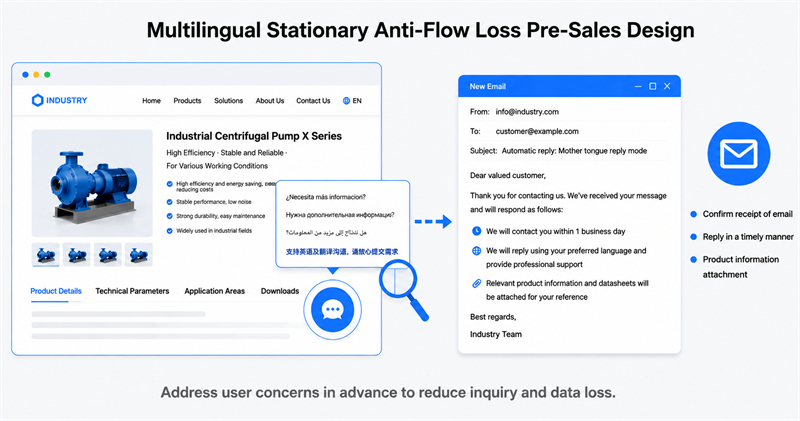
First, publicize communication rules in prominent positions. Enterprises can add clear prompts in local languages at high-traffic positions such as above inquiry forms, next to floating side chat buttons, and at the bottom of pages: “We support business communication in English. You may submit your requirements in your native language, and we will respond promptly and professionally.”
Informing users of communication methods in advance lowers their decision-making threshold and prevents them from leaving silently for fear their message will not be understood. According to independent website operation statistics, multilingual sites with such localized prompts see an average 21% increase in user inquiry submission rates and a 14% decrease in page bounce rates.
Second, configure multilingual auto-reply email templates. The 10 minutes after a user submits an inquiry is the golden response window; timely feedback can greatly reduce the probability of users turning to competitors. Enterprises need to pre-configure auto-reply emails in corresponding languages, covering three core points: first, confirm receipt of the inquiry and express thanks in the user’s native language; second, clearly state the response timeframe, for example, “We will formally reply to you in English with a translation in your native language within 2 working days”; third, attach basic materials such as general product catalogs and company profiles, so users can learn about the enterprise’s capabilities while waiting.
Native-language auto-replies not only demonstrate professionalism, but also set clear expectations for users, preventing churn caused by long periods without feedback.
Standardized Follow-up Process: Average Sales Staff Can Handle Inquiries Efficiently
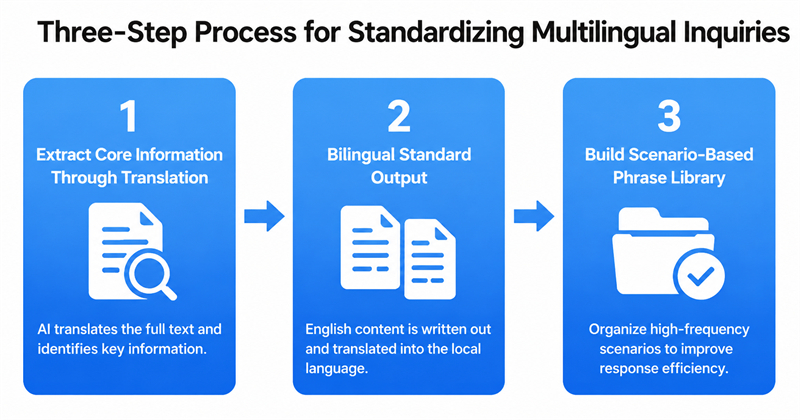
Even without full-time multilingual sales staff, enterprises can enable sales personnel with only English proficiency to handle multilingual inquiries efficiently through standardized processes, divided into three core steps.
Step 1: Unified translation and core information extraction. After receiving a multilingual inquiry, use professional translation tools to complete full-text translation, and manually mark core requirements such as product models, purchase volume, parameter specifications and delivery time to ensure no key information is missed. For ambiguous expressions, targeted confirmation can be included in the reply to avoid misinterpretation.
Step 2: Write in English and deliver in bilingual format. Sales staff draft replies according to the standard for regular English inquiries, covering demand responses, quotation details, cooperation processes, sample policies and more, to ensure rigorous and professional business expression. Once the reply is finalized, translate the main content into the local language and send it in the format of “original English text + multilingual translation”. This both ensures the standardization of business communication and allows the recipient to read quickly in their native language.
Step 3: Build a script library for high-frequency scenarios. For common communication scenarios such as quotation, sample delivery, parameter confirmation, logistics explanation and after-sales policy, sort out bilingual templates in advance. For subsequent use, only specific parameters need to be modified, which greatly improves response speed. At the same time, gradually accumulate a professional terminology glossary for the industry in daily work, continuously optimize translation accuracy, and build the enterprise’s own language assets.
Full-Link Empowerment: Xiamen FirstPageHelps Build a Conversion Closed Loop
As a Google Premier Partner for 11 consecutive years, Xiamen FirstPage has 20 years of experience in foreign trade digital marketing services and has served more than 10,000 foreign trade enterprises. We are well aware that the core concern of many enterprises when expanding into multilingual markets is not website construction and traffic generation, but back-end operation reception and conversion capabilities. Therefore, in addition to independent website construction and SEO traffic generation services, we provide a full set of website operation and inquiry conversion training to help enterprises open up the full link from traffic to orders.
To address language barrier issues, our training system covers three core modules: First, multilingual site conversion path design: we guide enterprises to complete the localized configuration of page prompts, inquiry forms and auto-reply emails, reducing user churn from the website end; Second, standardized inquiry follow-up training for sales staff: we teach efficient use of professional AI translation tools, construction of bilingual script templates, and establishment of industry terminology libraries, so that English-speaking sales staff can handle multilingual inquiries professionally and efficiently; Third, full-cycle conversion closed loop guidance: we build a complete follow-up system from initial response, demand exploration, sample follow-up to long-term customer maintenance, continuously improving the conversion rate and repurchase rate of multilingual customers.
Case Study: An industrial hardware enterprise in Jiangsu launched a Russian-language independent website in 2023. Since the team had no full-time Russian-speaking sales staff, it only drove a small amount of traffic in the initial stage. The inquiry response rate was less than 40%, and a large number of customer demands went unanswered.
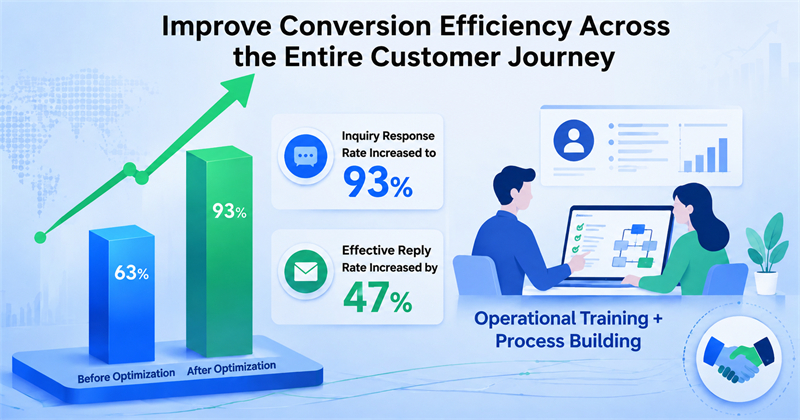
After partnering with Xiamen FirstPage, the enterprise’s team completed full multilingual operation and conversion training, optimized site prompts and auto-reply systems, and established a standardized inquiry handling process.
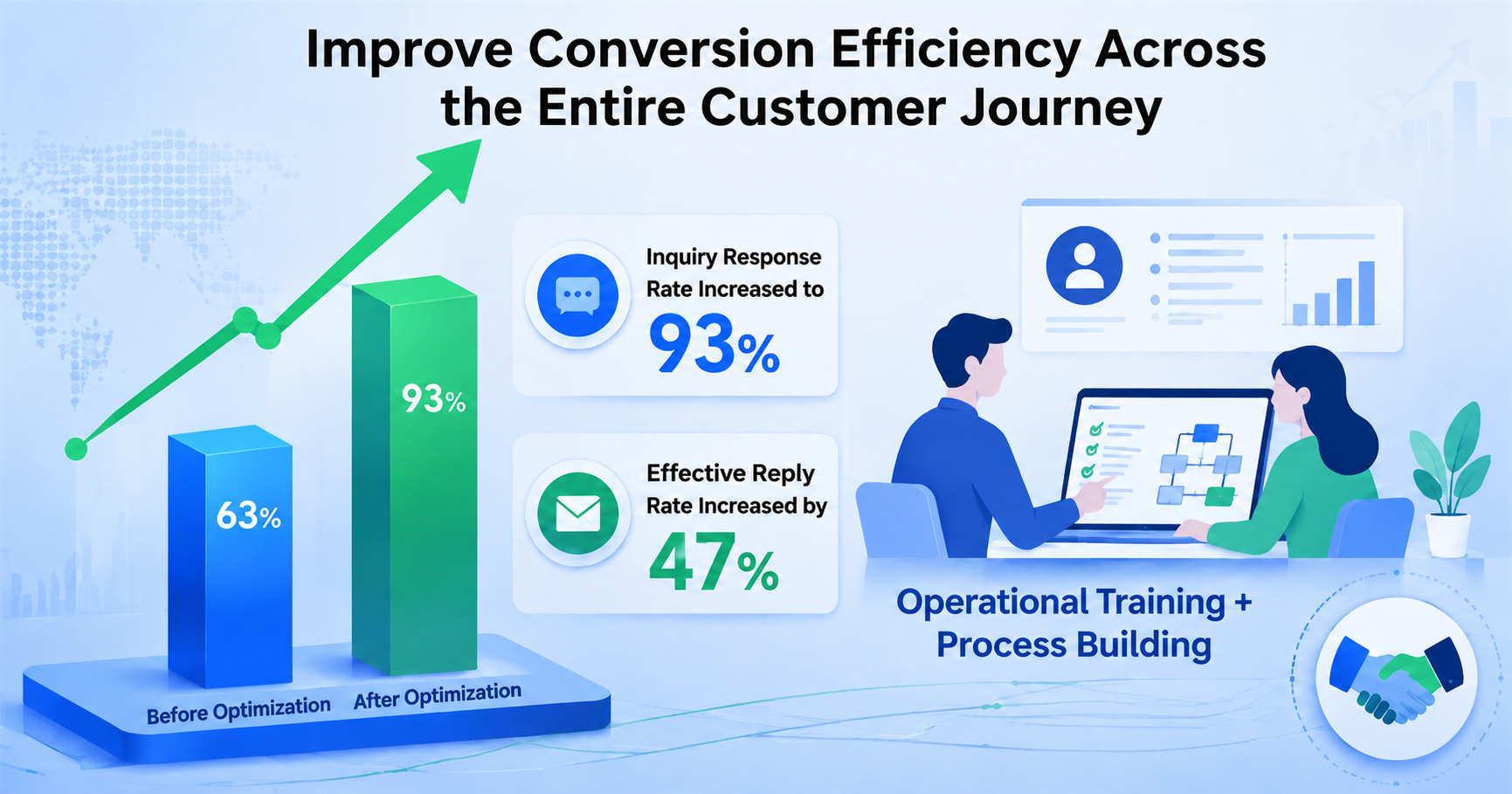
After 3 months of operation, the inquiry response rate of the Russian site rose to 93%, and the effective customer reply rate increased by 47%. Within half a year, the enterprise successfully signed 3 Russian orders worth over 1 million RMB each. Its overall conversion efficiency reached 89% of that of its English site. Throughout the process, it did not hire any full-time Russian-speaking sales staff, and opened up the Russian market at extremely low labor costs.
The core of expanding into multilingual markets has never been the presence of native-speaking sales staff, but systematic traffic reception and conversion capabilities. Today, with highly mature AI tools, language barriers can long be overcome through scientific website design, standardized follow-up processes and professional operation methods.
Xiamen FirstPage will continue to provide foreign trade enterprises with full-link services from website construction, traffic generation to conversion, helping enterprises expand into global non-English incremental markets at lower costs and with higher efficiency.