

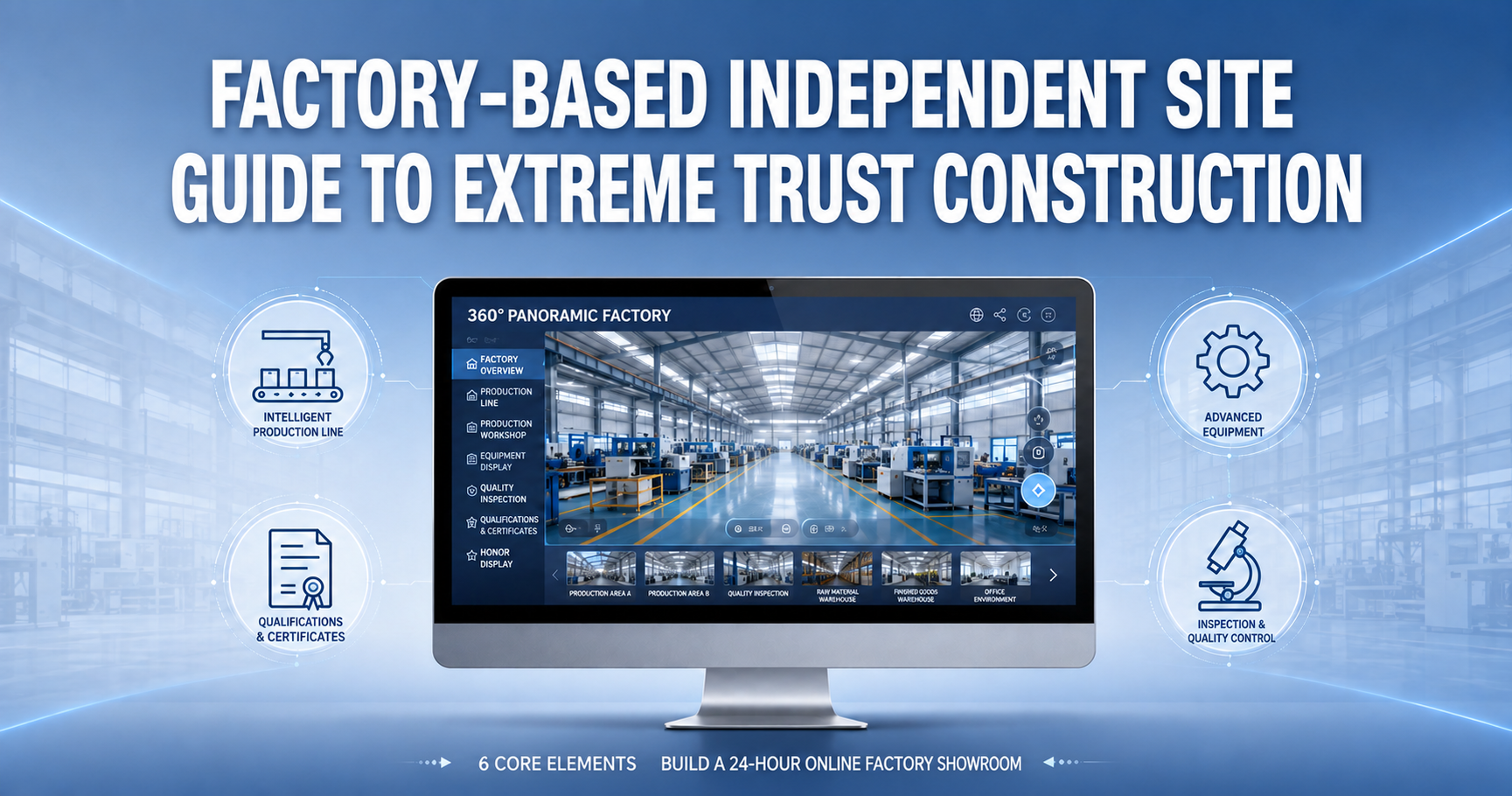
For manufacturing foreign trade enterprises, independent websites are far more than simple product display windows. They serve as core trust carriers that replace physical factory visits and secure large overseas orders. Many factory websites maintain steady traffic yet sustain an inquiry conversion rate below 1% for a long time. The root cause is straightforward: overseas buyers cannot conduct on-site inspections to distinguish genuine manufacturers from trading intermediaries, leading them to abandon cooperation due to insufficient trust.
Research data from a cross-border B2B industry survey reveals that 68% of industrial overseas buyers state that factory strength proof displayed on websites is the decisive factor for sending inquiries when in-person audits are impossible. Over 40% of buyers will label a business as a mere "intermediary" and halt communication if the site lacks tangible content such as production footage and qualification certificates. The core competitiveness of factory-focused independent websites never lies in polished product images; instead, it hinges on systematic content design that clearly demonstrates manufacturing capabilities to buyers.
1. Panoramic Production Footage: Replace On-Site Audits with Visual Content
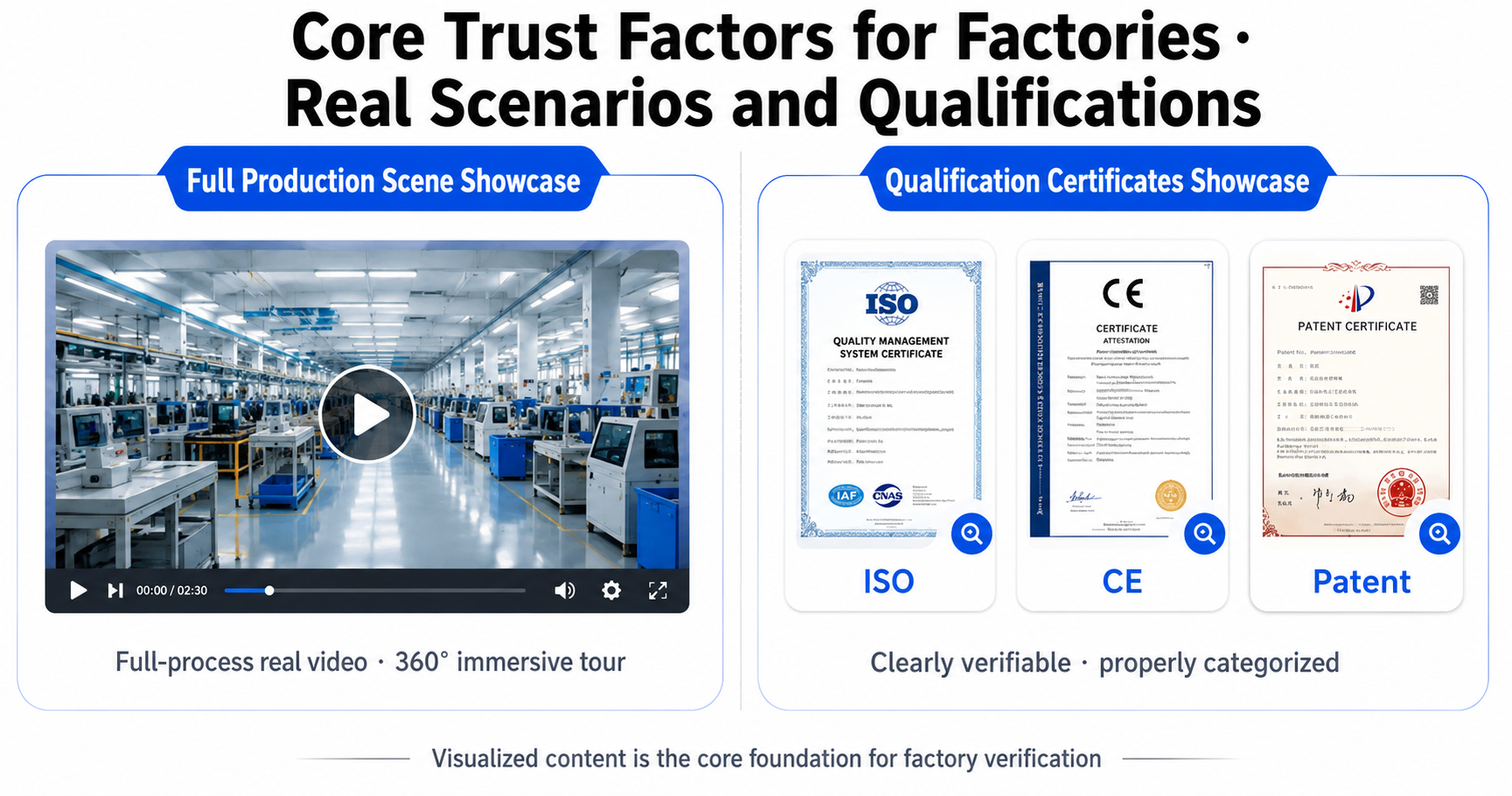
Empty slogans like "strong manufacturing capacity" and "original factory" fail to ease buyers’ doubts. Authentic, tangible production scenes form the foundational layer of trust. Numerous factory websites only post heavily retouched posed workshop photos with repetitive, monotonous angles, which buyers instantly recognize as artificial packaging. The correct approach is to deliver comprehensive panoramic production displays:
Industry operational statistics show that independent websites featuring complete factory real-scene videos boost average page dwell time by 45% and qualified inquiry conversion rates by 32% on average, making them the most cost-effective "online factory audit" solution.
2. Standardized Qualification Certificates: Hard Credentials to Reinforce Professional Credibility
Certifications including ISO management system accreditations, CE product certifications and industry access permits act as core benchmarks for overseas buyers to verify factory compliance. However, most enterprises present these documents in ways that drastically diminish their endorsement value. Common mistakes include blurry undersized certificate images scattered at the bottom of pages with no explanatory text. Standardized display follows three rules:
First, provide high-definition original copies of all credentials with clearly marked certificate numbers and valid dates that support zoom-in viewing for buyers to verify authenticity.
Second, categorize certificates into four groups: management system certifications, product safety accreditations, industry-specific qualifications and patents, paired with brief explanations of the capabilities each certification validates.
Third, place core credentials in prominent positions below the above-the-fold homepage section, rather than burying them deep within multi-level subpages.
Independent website conversion data indicates factory sites with clear, standardized displays of authoritative certifications see a 58% average rise in buyers’ trust scores, alongside a notable increase in inquiries from major clients.
3. Systematic R&D & Quality Control Showcase: Highlight the Factory’s Core Technical Barriers
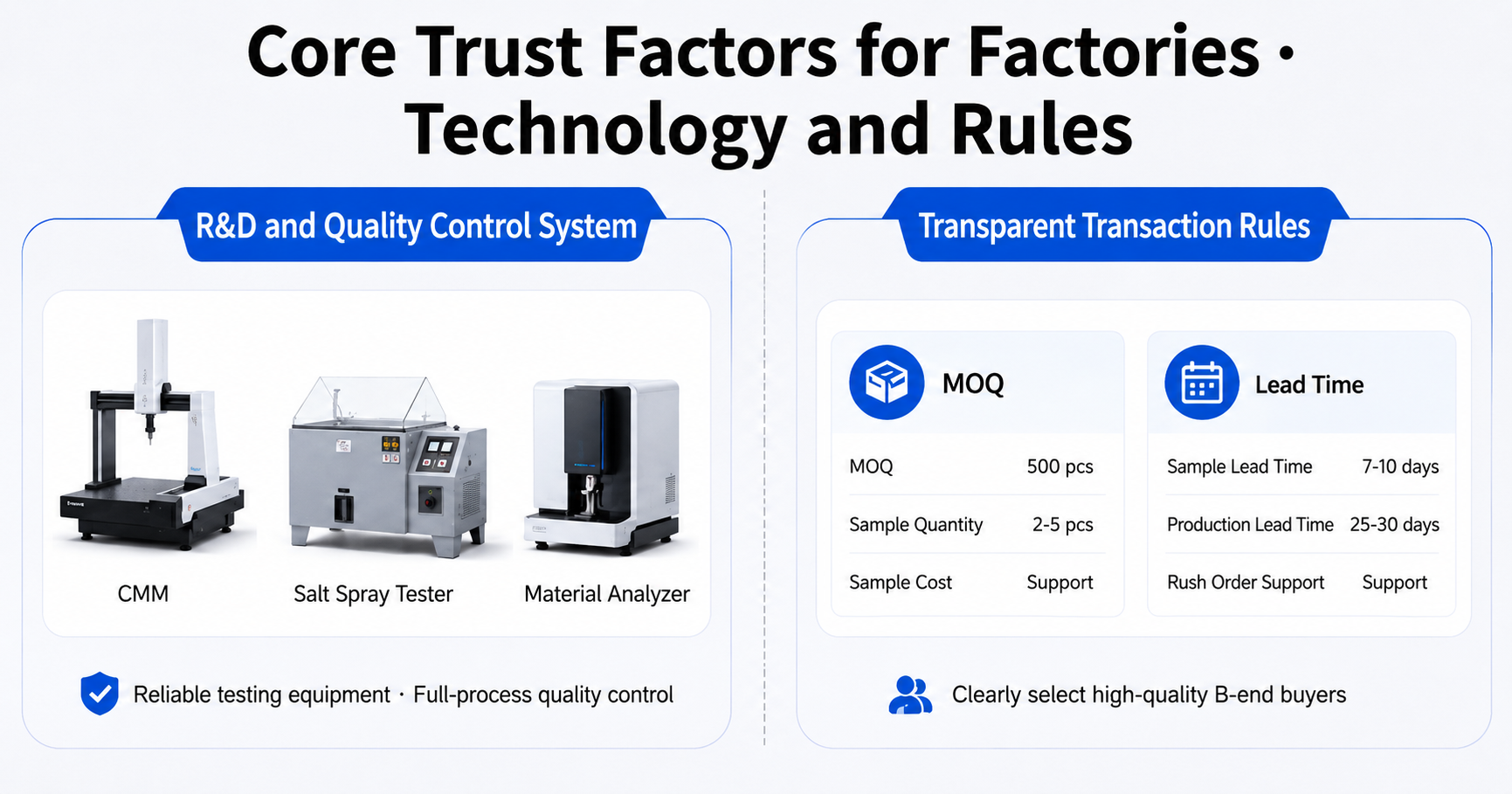
When screening suppliers, large overseas buyers prioritize not only production capacity but also technical stability and quality control capabilities—key differentiators separating small workshops from formal manufacturers. Most factory websites only briefly mention "a professional R&D team" with no supporting evidence, which lacks persuasion. Comprehensive R&D and QC displays consist of three parts:
First, details on R&D team size, senior engineers’ years of industry experience, annual R&D investment proportion, and the number of invention and utility model patents obtained.
Second, a list and real photos of core testing equipment, such as coordinate measuring machines, salt spray testers and material analyzers, to tangibly demonstrate robust QC hardware.
Third, a breakdown of standardized quality control workflows, covering incoming material inspection, in-process sampling and full finished product testing, to illustrate the complete quality management chain.
For sectors including machinery, hardware and electronic components, the comprehensiveness of R&D and QC content directly determines the willingness of big-ticket buyers with annual purchasing volumes worth millions of US dollars to enter partnerships.
4. Transparent Transaction Terms: Screen High-Quality Clients via MOQ & Lead Time
Many factories fear disclosing minimum order quantities (MOQ) and lead times will scare off potential customers, so they deliberately obscure this information. This practice instead attracts numerous low-value small-order inquiries and wastes the sales team’s energy. In reality, B2B bulk purchasers value full transparency over transaction rules. Clearly stating MOQ serves two purposes: it filters out mismatched small-scale buyers so sales staff can focus on high-value clients, and signals standardized, legitimate factory operations to build greater trust. Lead times should be split for standard and customized products, with production cycles listed for different order volumes, plus explanations of core factors affecting delivery schedules to demonstrate professional capacity planning.
Statistics show factory sites with clearly marked MOQ and lead time reduce invalid inquiries by 37%, lift the share of high-intent major buyer inquiries by 29%, and drastically improve overall communication efficiency.
5. Tangible Cooperation Cases: Eliminate Decision Doubts with Real Proof
Verified past cooperation records carry more weight than self-promotional corporate descriptions, yet most factory case pages only display client logos with little practical reference value. Trustworthy case presentations require tangible details:
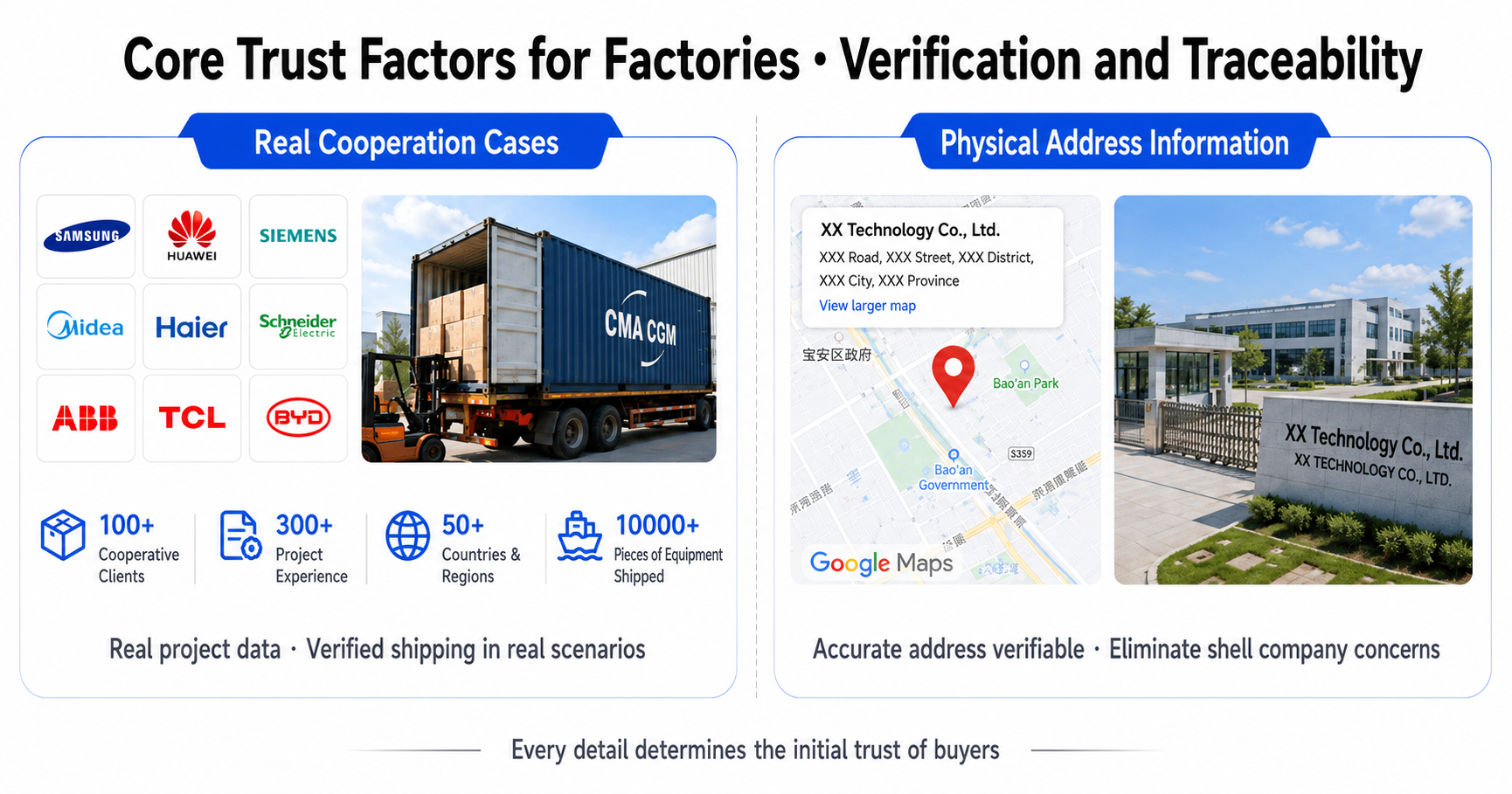
First, display official logos of partner brands with client authorization, prioritizing well-known industry enterprises to create brand endorsement effects.
Second, supplement photos of outbound shipments, container loading and factory audit meetings (with sensitive information pixelated) to validate genuine cooperation.
Third, add concise descriptions of typical projects, e.g., "Custom mold supplier for a European automotive brand, annual procurement volume of 1.2 million euros, 5-year partnership", using concrete figures to strengthen persuasiveness. Factories that have undergone third-party audits may also display the cover and conclusion pages of audit reports for further credibility.
6. Visible Physical Information: Dispel "Shell Company" Suspicions with Real Addresses
Many trading companies disguise themselves as manufacturers, and the most direct proof of a genuine factory is a complete physical address and offline contact information. Key optimization details include:
First, post the full factory address down to the exact house number in the website footer and Contact Us page, with an embedded Google Maps pin allowing buyers to view the factory location and surrounding environment directly.
Second, upload real photos of the factory gate, doorplate and office building exterior to confirm the authenticity of the registered address.
Third, provide a fixed factory landline and dedicated contact channels for each business department, instead of only offering online forms and personal email addresses.
Though these details seem trivial, they form the baseline standard buyers use to judge whether a company is a shell operation. Properly showcasing this information significantly lowers users’ initial wariness.
Xiamen FirstPage: Exclusive Trust Endorsement System for Factory-Focused Websites
As an 11-consecutive-year Google Premier Partner, Xiamen FirstPage boasts 20 years of foreign trade digital marketing experience and has served over 10,000 foreign trade enterprises. Catering to manufacturing companies’ website building demands, we have developed an exclusive "Factory Trust Endorsement" module within our custom B2B website construction service. Content layout logic is designed around overseas buyers’ decision-making journeys, upgrading factory websites from mere product showcases to credible demonstrations of manufacturing strength.
During website development, our team customizes the display format and page placement of the six trust-building elements according to the factory’s industry vertical, product range and target markets. This balances persuasive content presentation with Google’s crawler rules, driving simultaneous improvements in search indexing, rankings and conversion efficiency.
Practical Case Study
An injection molding factory based in Guangdong previously ran a self-built website featuring only product images and brief introductions. Its inquiry conversion rate lingered below 0.8%, with nearly all leads being small sporadic orders and very few inquiries from major clients.
After partnering with Xiamen FirstPage, our team rebuilt its factory-focused independent website and constructed a full content system based on the six trust elements: embedded full-process workshop footage, standardized displays of ISO and IATF16949 certifications, supplemented R&D testing equipment and QC workflows, clearly marked MOQ and lead times for all product lines, and launched dedicated pages for client cooperation cases and factory physical information.
After four months of operation, the site’s inquiry conversion rate rose to 2.3%, while the proportion of major buyer inquiries jumped from 12% to 35%. The factory successfully secured an annual multi-million-euro order from a renowned European automotive brand.
The inability to host on-site audits does not equate to an inability to build deep buyer trust. At its core, a factory-focused independent website acts as a 24-hour online factory showroom. Systematic optimization across six dimensions — production footage, official qualifications, R&D capabilities, transparent transaction rules, cooperation cases and physical business credentials — creates sufficient trust to attract and convert high-value overseas bulk buyers. Xiamen FirstPage will continue to deepen its expertise in factory-oriented B2B website construction, helping more manufacturers build high-trust, high-conversion foreign trade independent websites.
Have questions? Let’s chat
Our team is ready to serve you.
We provide
free consultation.
Let’s get started!