

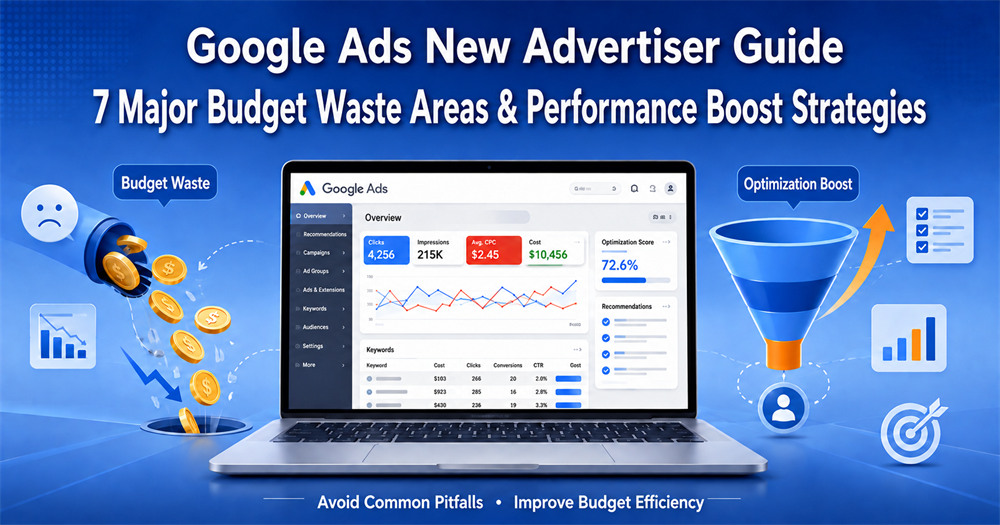
For export businesses setting up Google Ads for the first time, the most common dilemma for novice operators is this: despite continuous budget investment, valid inquiries are scarce, and the ROI falls far below expectations. Many companies attribute this to fierce industry competition and rising cost-per-click (CPC), ignoring the hidden budget waste at the basic operational level. According to cross-border B2B digital marketing industry research, Google Ads accounts managed by beginners have an average budget waste rate of 40%-52%. Furthermore, the cost per valid inquiry for nearly 60% of companies in their first 3 months of advertising is more than double the industry average for mature operations. The vast majority of budget depletion does not stem from market competition, but rather from basic operational misunderstandings and a lack of refined management.
The performance of Google Ads relies heavily on the precision of operations. Common operational mistakes made by beginners will continuously drain the budget without bringing in corresponding commercial value. Clarifying the 7 most frequent budget-wasting operations is the first step for beginners to improve their advertising efficiency.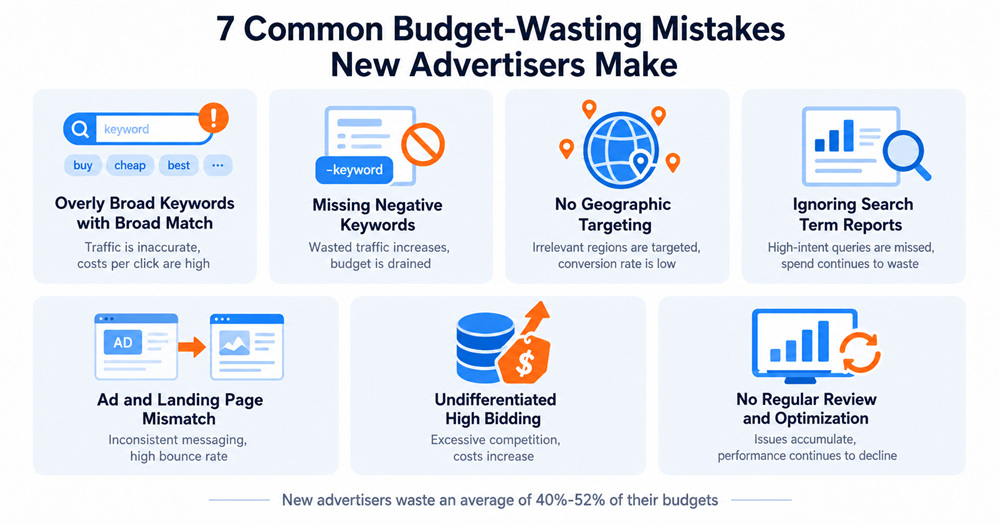
1. Broad Match for Generic Keywords: The Largest Source of Irrelevant Clicks and Waste
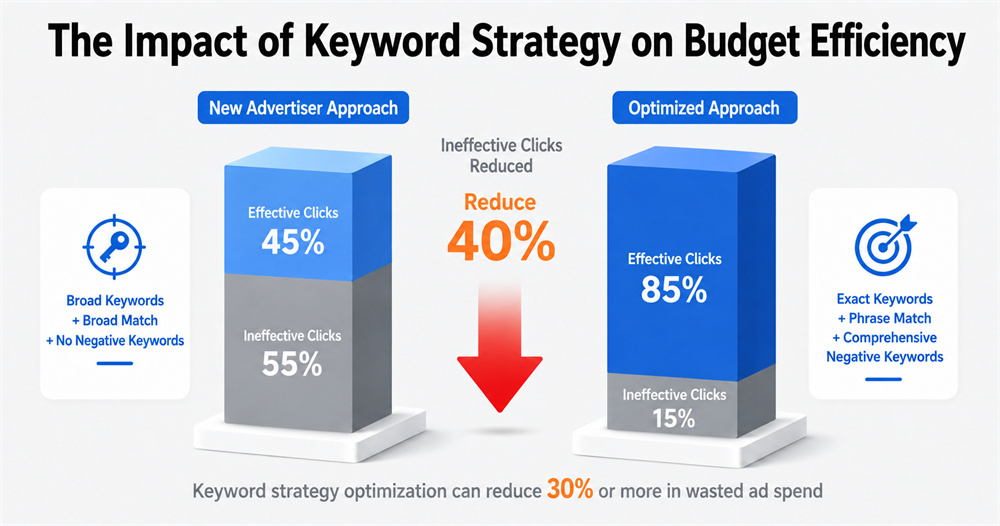
The most common mistake beginners make is selecting generic keywords for core products and keeping the Broad Match mode on by default, assuming that a wider reach will result in more customer acquisition opportunities. In reality, under Broad Match, Google will expand to a large number of search terms without purchasing intent based on semantic associations, such as industry knowledge, repair tutorials, and job recruitments. These clicks generate no commercial value but will fully consume your budget. Taking the machinery category as an example, if you bid on the generic keyword "stainless steel valves" using Broad Match, non-purchasing search terms triggered—such as "stainless steel valve repair methods," "valve working principles," and "valve factory recruitment"—can account for over 40% of the traffic.
Industry audit data shows that the combination of purely generic keywords and Broad Match typically results in an invalid click rate of 35%-50%, meaning that nearly half of the budget is spent on non-target users.
2. Missing Negative Keywords: Passively Receiving Massive Irrelevant Traffic
Many beginners are unaware of the role of negative keywords and never add them after the account goes live, leading to ads being continuously triggered by irrelevant searches. Official Google research indicates that companies can waste up to 25% of their budget on irrelevant clicks, while beginner accounts generally see a waste rate close to 40% due to the lack of negative keyword configurations. For B2B export accounts, generic terms like "free," "used," "tutorial," and "jobs," as well as misaligned terms like "wholesale" or "dropshipping," will trigger invalid clicks. Properly configuring negative keywords can reduce invalid advertising costs by 15%-30%. Pre-setting a basic negative keyword library initially and continuously updating it based on the Search Terms Report is the most cost-effective budget optimization strategy.
3. Indiscriminate All-Region Targeting: Low-Intent Markets Diluting Ad Performance
Beginners often default to targeting all English-speaking countries or all target continents, believing that covering more markets means more order opportunities. However, purchasing intent, competition levels, and CPC vary wildly across different regions. Large click volumes with low conversions in non-core markets will heavily dilute the budget and drag down overall ROI. In industrial product advertising, for example, North America and Western Europe are core markets with high intent; their CPC is high, but the conversion quality is excellent. In contrast, some Southeast Asian and African markets yield high click volumes but very little valid purchasing demand, with invalid consumption reaching over 60%. Focusing the budget on core target markets delivers a conversion efficiency over 50% higher than a broad, all-region approach.
4. Ignoring the Search Terms Report: Failing to Track Where the Budget is Actually Spent
The Search Terms Report is the core tool for pinpointing where your budget is going, yet many beginners never check it after launching campaigns. They only look at total clicks and total spend, unaware of which search terms triggered their ads and which ones drove conversions. Over time, underperforming search terms continually drain the budget, while high-converting terms do not receive sufficient budget allocation, causing the overall campaign structure to deteriorate.
Operational data reveals that accounts reviewing the Search Terms Report at least twice a month have a budget utilization rate over 40% higher than those that never review it. Weekly troubleshooting to pause low-efficiency search terms and promptly add corresponding negative keywords is a foundational step in controlling budget waste.
5. Misalignment Between Ads and Landing Pages: Disconnected Clicks and Conversions, Resulting in Wasted Budget
A high-frequency issue among beginners is the mismatch between the products, advantages, or policies promoted in the ad copy and the actual content of the landing page. For instance, if an ad highlights "custom manufacturing" but the landing page only displays standard product descriptions, or if the ad states "MOQ 100" but the landing page says "MOQ 500," users will bounce immediately upon discovering the discrepancy. This completely wastes the cost of the click, lowers the ad's Quality Score, and further drives up future bids.
Industry data shows that accounts with highly matched ad and landing page content have an average bounce rate 35% lower than misaligned accounts, boosting conversion efficiency by more than 40%.
6. Indiscriminate High Bidding: Blind Bidding Driving Up Customer Acquisition Costs
To gain quick exposure, beginners often choose the "Maximize Clicks" bidding strategy, or directly set bids far above the industry average, assuming that higher rankings equal better results. In reality, ad rank only affects impressions and does not directly dictate conversions. Excessively high bids will drastically inflate the CPC, exceeding the reasonable threshold corresponding to the conversion value.
Based on industry benchmarks for B2B industrial categories, a reasonable CPC falls within the $4.5-$6.8 range. If a beginner bids over $8, they might secure a top position, but the click cost significantly exceeds reasonable levels, pushing the cost per inquiry far beyond the normal industry range.
7. Lack of Periodic Review and Optimization: Underperforming Ad Groups Constantly Draining Budget
Many beginners believe their job is done once the account is set up and ads are live. They neglect subsequent data reviews and strategy adjustments, allowing low-efficiency ad groups, keywords, and creatives to continually consume the budget, while high-converting segments are starved of resources. The market environment, competitive landscape, and user search behaviors on Google Ads are incredibly dynamic. For accounts that go unadjusted long-term, campaign performance will decline month by month.
Industry data indicates that accounts maintaining minor weekly optimizations and comprehensive monthly reviews achieve an ROI over 60% higher than unoptimized accounts after 3 months of running campaigns.
Paths to Improving Beginners' Advertising Efficiency and Professional Support
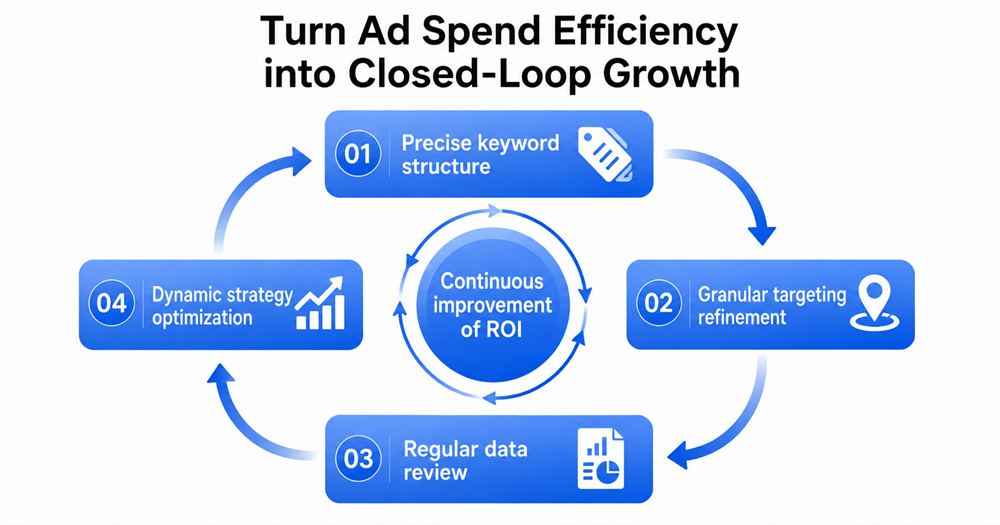
For export enterprises, the core objective during the beginner stage is not to chase maximum traffic, but to acquire sufficient valid inquiries with a limited budget and control budget waste. Beyond avoiding the 7 operational pitfalls mentioned above, it is far more important to establish a full-process refined management system—spanning account setup and keyword strategy to data reviews.
As a Google Premier Partner for 11 consecutive years, Xiamen First Page possesses 20 years of experience in foreign trade digital marketing, having served over 10,000 export businesses. Addressing the Google Ads pain points of beginner enterprises, we offer full-process ad management services: from the account setup phase, we handle keyword tiering, match type configuration, negative keyword library integration, precise regional targeting, and landing page compliance optimization, preventing fundamental operational errors from the source. During the campaign, we monitor data weekly and conduct comprehensive monthly reviews, dynamically adjusting keywords, bids, and creatives to continuously enhance budget utilization efficiency.
Case Study
A building materials export company in Foshan, Guangdong, ran its first Google Ads campaign managed by an in-house beginner with a monthly budget of 12,000 RMB. After 3 months, they averaged only 5 valid inquiries per month, with the cost per inquiry exceeding 2,400 RMB, indicating severe budget waste. After partnering with Xiamen First Page, our operations team conducted a comprehensive account diagnostic: we paused the Broad Match mode for generic terms, switching to Exact + Phrase Match; added over 200 general industry and product-specific negative keywords; narrowed the target regions to core European and American markets; optimized the alignment between ad creatives and landing pages; and established a weekly data review mechanism.
After 2 months of optimization, the account's average monthly valid inquiries increased to 11, the cost per inquiry dropped by 48%, and budget utilization efficiency more than doubled, bringing their campaign performance up to mature industry standards.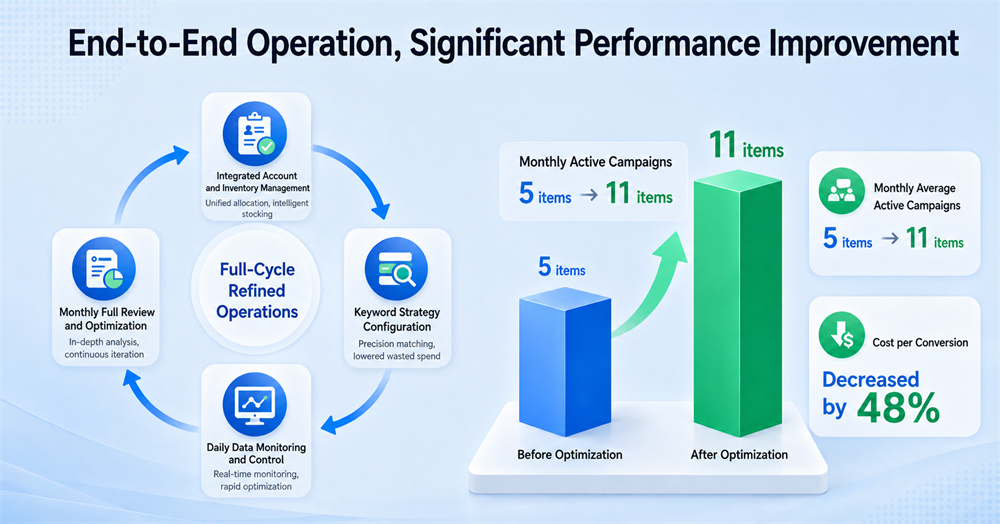
The vast majority of budget wasted in beginner Google Ads campaigns stems from blind spots in basic operations, rather than uncontrollable market factors. By proactively avoiding common pitfalls and establishing a refined review mechanism, you can achieve higher advertising efficiency with a limited budget. Xiamen First Page will continue to leverage its professional full-funnel Google service capabilities to help export beginners skip the trial-and-error phase and achieve efficient, stable overseas customer acquisition.