

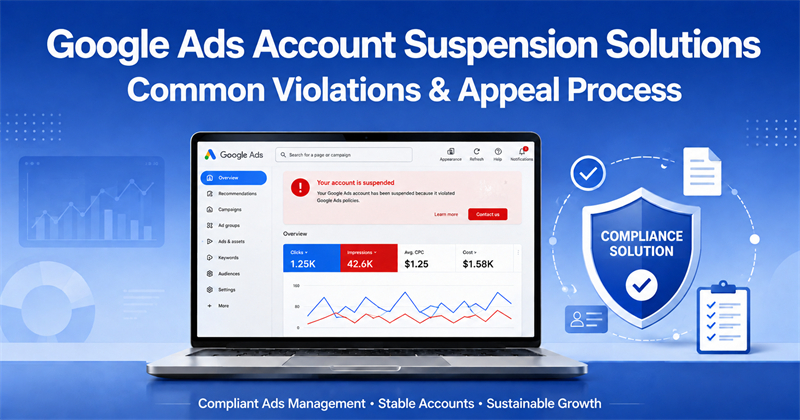
For foreign trade enterprises relying on Google channels for customer acquisition, a sudden Google Ads account suspension means a direct disruption of traffic links, stagnation of inquiries, sunk budgets, and disrupted business rhythms. Many companies have an insufficient understanding of the platform's rules. They either appeal blindly and fail repeatedly, or directly abandon the account and open a new one, which instead triggers an associated suspension and causes greater losses. Industry data shows that about 65% of routine policy-related suspensions can be successfully appealed through compliance remediation. However, over half of the companies fail in their appeals due to improper operations, with misjudgment of the suspension reasons and incomplete remediation being the core issues.
Google Ads suspensions fall into two categories: warning-type violations follow a graduated mechanism of cumulative suspension after four warnings, providing a clear window for remediation; severe violations result in an immediate permanent suspension without prior warning. Clarifying common reasons for violations and the standard appeal process is an essential skill for foreign trade enterprises to manage account risks.
I. Six Common Violation Reasons for Google Ads Account Suspensions
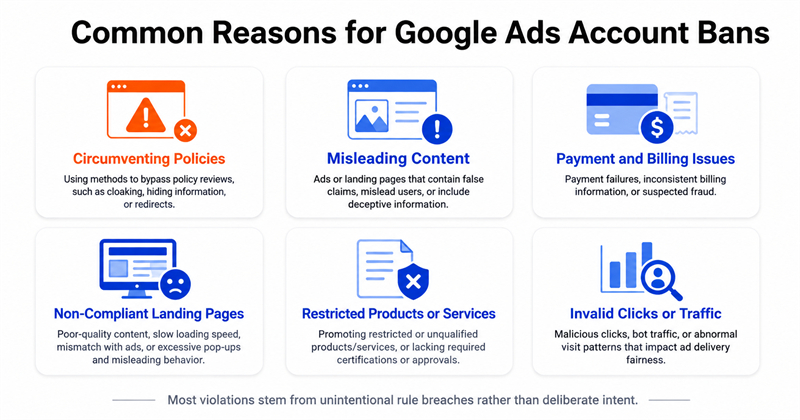
The essence of an account suspension is triggering the platform's trust and risk control mechanism. High-frequency violations in the foreign trade B2B scenario are concentrated in six categories, most of which stem from blind spots in understanding the rules rather than subjective malice.
1. Circumventing Systems: The Most Severe Cause for Permanent Suspension
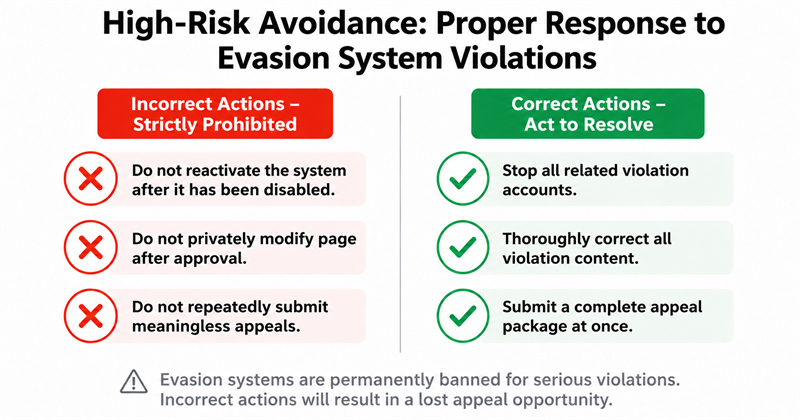
Opening multiple duplicate accounts under the same business entity to disperse ad delivery and circumvent single-account review rules; or privately modifying the landing page to contain non-compliant content after the ad is approved. The most common pitfall for foreign trade enterprises is "opening a new account once banned." Google identifies associated accounts across multiple dimensions such as domains, entity qualifications, payment information, and IP addresses. New accounts are highly likely to be suspended by association, resulting in the complete loss of any room for appeal.
2. Misrepresentation: The Most Frequent Routine Violation
Misrepresentation is the most frequent reason for suspension, with Google blocking 146.9 million misleading ads in 2024. For foreign trade B2B enterprises, common triggers include: exaggerating product performance and production capacity, forging industry certifications like ISO/CE, stating false minimum order quantities (MOQs) and delivery times, using absolute promotional terms like "lowest price on the web" or "industry number one," and fabricating cooperation cases and brand endorsements. Many companies believe that "moderate exaggeration is normal," but Google's algorithm cross-verifies landing page content, third-party qualification information, and user feedback. Once it determines that the content does not match the facts, it will, at best, reject the ads, and at worst, directly suspend the account.
3. Payment and Billing Anomalies: High-Frequency Risk Control Triggers
Google exercises extremely strict risk control over the payment process, and payment anomalies will directly trigger account suspension. Common issues include: using invalid or expired credit cards, billing addresses not matching the enterprise's registered address, multiple failed payments left unresolved, a history of chargebacks, and using personal payment accounts not belonging to the business entity to recharge. If foreign trade enterprises frequently change payment methods or use cross-entity payments, the system is very likely to flag them as suspicious payment behaviors, freezing the account first for verification and thereby affecting the normal delivery pace.
4. Landing Page Experience Violations: The Most Easily Ignored Hidden Minefield
Many companies focus only on ad copy compliance while ignoring landing page experience requirements, ultimately leading to account suspensions due to page issues. Common violations include: ad content not matching the landing page product, landing pages being inaccessible or failing to load, lacking complete company contact information and privacy policies, and the presence of forced pop-ups, malicious redirects, or clickbait elements. For factory-type independent websites, incomplete landing page information and missing contact details are frequent issues. These can cause the system to label the site as an "untrustworthy merchant," leading to reduced ad rankings or triggering account reviews and suspensions.
5. Restricted Categories and Missing Qualifications
Certain industrial, medical, and security products fall under Google's restricted advertising categories. They require the advance submission of corresponding qualifications to complete certification; advertising directly without qualifications will trigger a suspension. Furthermore, if a company simultaneously opens a Google Merchant Center (shopping ads account), a GMC violation and suspension will also implicate the associated Google Ads account, creating a "guilt by association" effect. This is a risk point easily overlooked by companies advertising multiple products.
6. Invalid Clicks and Abnormal Traffic
If an account experiences a large number of abnormal invalid clicks or malicious traffic from non-target areas, the system will determine that the account has a risk of traffic fraud. It will pause ad delivery first and only restore it after verification. Some companies manually click on ads or use third-party click-farming tools to boost data; these actions will directly trigger a suspension, and the appeal success rate is extremely low.
II. Standard Appeal Process and Practical Points for Account Suspensions
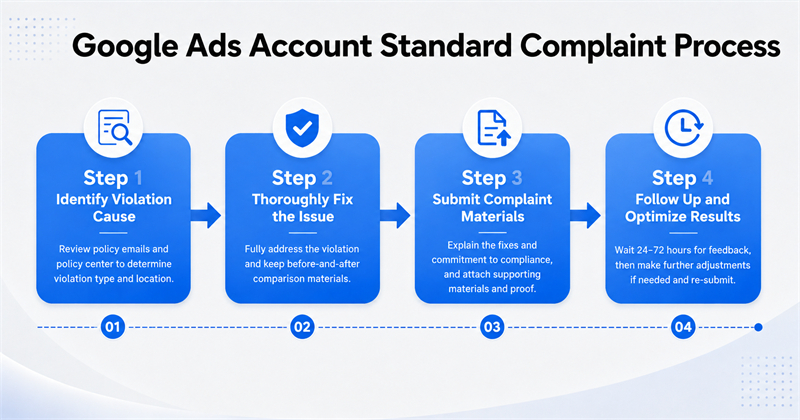
An account suspension is not irreversible. For routine policy violations, as long as the remediation is thorough and the appeal materials are standardized, there is a high probability of recovery. The official standard appeal process consists of four steps, each of which directly affects the success rate of the appeal.
Step 1: Accurately Pinpoint the Cause of Violation and Avoid Blind Appeals
After suspension, the account can still be logged into with read-only access. First, check the suspension notification at the top of the account and the Policy Manager page to view the specific violated policy items and violation locations. Determine whether it is a single-ad violation or an account-level suspension, and whether it is a warning-type or severe violation. Never submit an appeal without clarifying the reasons, and do not repeatedly submit appeals with the same content —— repeatedly submitting meaningless appeals for the same suspension will be flagged by the system as malicious appeals, prolonging the processing time or even resulting in direct rejection.
Step 2: Thoroughly Remediate the Root Cause of the Violation
The prerequisite for an appeal is that the violation issue has been completely resolved; appealing directly without remediation will fail 100% of the time. If it is a misrepresentation violation, delete all exaggerated statements on the landing page, replace them with true and verifiable content, and supplement corresponding qualification proofs. If it is a landing page experience violation, complete the company information and privacy policy, and fix redirection and loading issues. If there are payment anomalies, update to a valid payment method and verify that the billing address matches the entity. If it is a circumventing systems violation, first shut down all associated violating accounts and clean up duplicate ad content. After remediation is complete, keep before-and-after comparison screenshots and update logs as supporting evidence for the appeal.
Step 3: Standardize the Submission of Appeal Materials
Submit the application through the appeal portal within the account or the official appeal form. The appeal content must include four core elements: a clear statement of understanding the corresponding violation policy, a clear description of specific remediation actions, a commitment to strictly abide by platform rules in the future, and attached supporting materials (business license, industry qualifications, remediation screenshots, payment vouchers, etc.). The appeal statement should be objective and professional, avoiding emotional defenses. Keep the length between 300-500 words, focusing on remediation actions and compliance commitments, and do not pile on irrelevant content.
Step 4: Follow Up on Results and Secondary Appeals
The official processing time for routine appeals is 24-72 hours, while complex violation cases may extend to 1-2 weeks. If the first appeal is rejected, read the rejection reasons carefully, supplement remediation and supporting materials for the unapproved parts, and then submit a second appeal. Do not submit the exact same appeal repeatedly. The platform has strict limits on the number of appeals for a single violation; frequent submissions will trigger a cooldown period, ultimately prolonging the processing time.
III. Xiamen First Page: Compliant Ad Operations and Professional Appeal Support
As a Google Premier Partner for 11 consecutive years, Xiamen First Page has 20 years of experience in foreign trade digital marketing and has served over 10,000 foreign trade enterprises. Our Google Ads management service has established a complete compliance control system: before delivery, we conduct a full-dimensional compliance pre-check on account qualifications, landing page content, and product categories to avoid violation risks from the source; during delivery, we conduct monthly policy inspections, synchronize with Google's latest rule adjustments, and provide timely warnings of potential risks. In the event of an account suspension, an exclusive team familiar with platform policies will assist in locating the problem, completing the remediation, and preparing appeal materials, thereby significantly increasing the appeal success rate.
Practical Case
During its self-managed Google Ads campaign, an industrial screening equipment company in Shandong had its account suspended due to a misrepresentation violation triggered by labeling false production capacity parameters on its landing page and failing to fully display CE qualifications. The company's two self-submitted appeals were rejected, the account was disabled for nearly three weeks, and the peak season advertising plan came to a complete halt. After partnering with Xiamen First Page, our team first verified the violation items, assisted the company in comprehensively modifying the parameter descriptions on the landing page, supplemented complete CE qualification documents and product test reports, and adjusted the promotional content based on the company's true production data. Following this, we organized the appeal materials according to official standards, clearly explaining the remediation actions and subsequent compliance control plans. On the 5th working day after submitting the appeal, the account successfully resumed ad delivery. Subsequently, the team conducted monthly compliance inspections. During 12 months of continuous operation, no further policy violations occurred, and the stability of account delivery improved significantly.
A Google Ads account suspension is not intimidating; most routine violations can be restored through compliance remediation. The real risk lies in ignorance of the rules and erroneous operations. For foreign trade enterprises relying on Google channels, proactive compliance control is far more important than appealing after a suspension. Professional account operations can both reduce the probability of violations and ensure the stability of the delivery pace. Xiamen First Page will continue to deeply cultivate full-funnel Google services, helping foreign trade enterprises achieve stable and efficient overseas customer acquisition under the premise of compliance.