

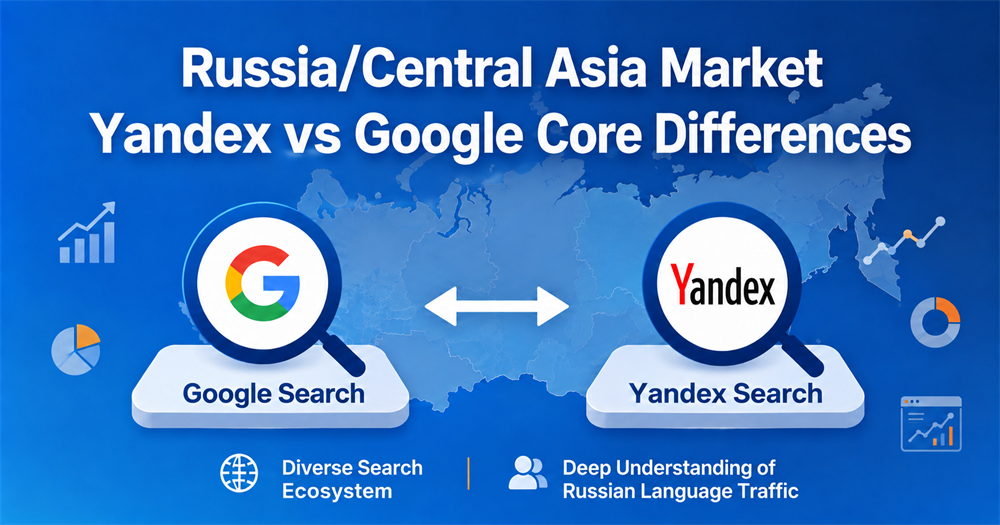
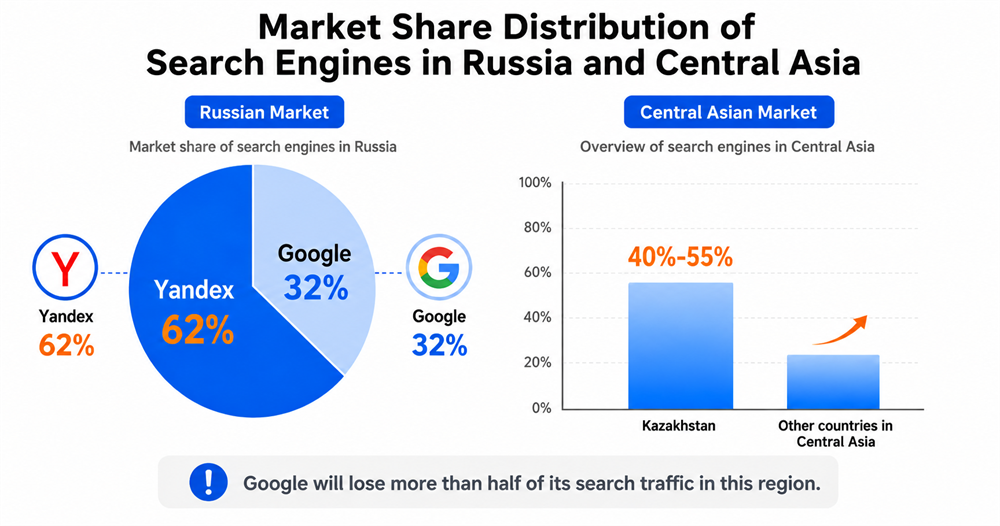
Foreign trade enterprises targeting the Russian and Central Asian markets often have a misconception: they believe that doing Google SEO well is enough to handle Russian foreign trade independent website promotion and cover all search traffic. In reality, the Russian-speaking region has an independent local search ecosystem. As the mainstream regional search engine, Yandex's penetration rate in the local market far exceeds that of Google. According to 2024 SimilarWeb data, Yandex holds about 62% of the market share in the local Russian search market, while Google only accounts for 32%; in Central Asian countries with high Russian penetration, such as Kazakhstan and Uzbekistan, Yandex's market share also reaches 40%-55%. Therefore, if you want to succeed in Central Asian B2B market development, solely focusing on Google is equivalent to giving up more than half of the local search traffic.
Many enterprises try to run Yandex optimization using Google's optimization logic, but consistently struggle to achieve ideal rankings. The core reason lies in the fundamental differences in their algorithm logic, weighting standards, and ecological systems. Blindly copying general SEO experience cannot adapt to the rules of local search engines. Only by clarifying the core differences can you truly leverage the traffic growth in the Russian-speaking region.
1. Differences in Semantic Understanding: Completely Different Depths of Russian Localization
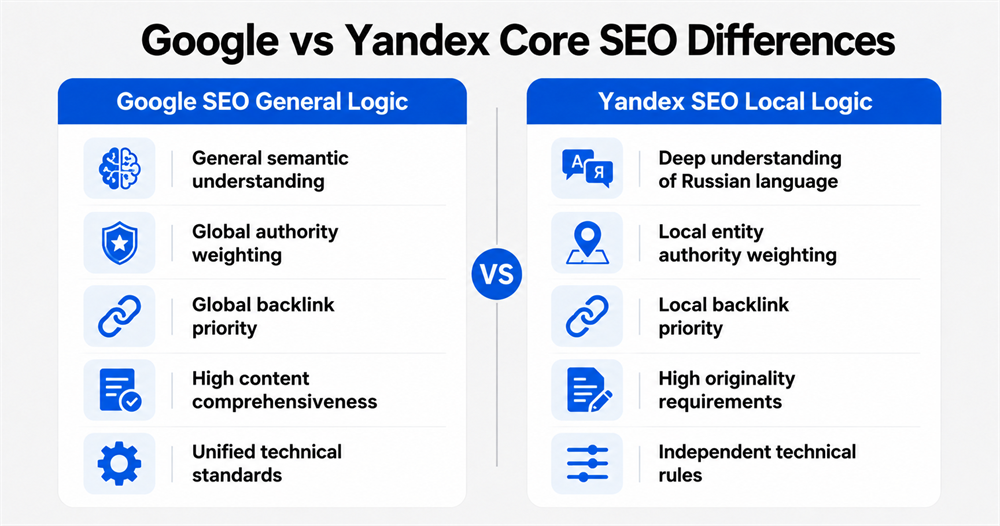
Google's search algorithm is based on a global universal semantic model. Its adaptation to Russian relies on a general corpus, leaning more towards standardized written expressions; meanwhile, Yandex, as a local search engine, possesses a depth of understanding of Russian morphology, grammatical structures, industry terminology, and regional slang that far exceeds Google's, resulting in extremely strict requirements for content localization.
For B2B foreign trade websites, Russian content generated directly by English machine translation might achieve basic rankings on Google, but it will struggle to make it to the first two pages of Yandex search results. The Yandex algorithm accurately identifies stiff translated content that does not conform to native Russian speaking habits and penalizes its weighting. This is the core reason why many enterprises report that "the Russian site has traffic on Google, but almost zero indexing on Yandex."
2. Differences in Ranking Weights: Higher Priority for Local Entity Signals
The core weighting of Google international site SEO favors the overall authority of the website, with local signals only affecting specific local search scenarios; conversely, in Yandex's ranking logic, local entity signals are core weighting factors, and their priority is significantly higher than on Google.
Specifically, professional Yandex Business registration (Yandex Business Directory), labeling real local office addresses and landlines in Russia / Central Asia, and binding Yandex Map locations—these operations can directly improve a site's search rankings. For B2B procurement scenarios, Yandex prioritizes showing users suppliers with physical entity certification, thereby lowering the trust cost for buyers. Many enterprises with purely overseas websites and no local entity information consistently rank poorly on Yandex, and their core shortcoming lies precisely in this lack of local signals.
3. Differences in Backlink Systems: Local Relevance Outweighs Global Authority
Google's backlink evaluation logic leans towards "global authority," where backlinks from global high-authority domains hold more value, focusing heavily on the overall weight and industry relevance of the linking sites; on the other hand, the Yandex backlink system leans more towards "local relevance," where backlinks from local Russian-speaking domains like .ru, .рф, and .kz carry far more weight than general international domains.
For B2B websites, backlinks from local Russian vertical industry forums, regional B2B platforms, and industrial category directories have a significant boosting effect on Yandex rankings; conversely, backlinks from global authoritative media and general educational domains, which perform outstandingly on Google, account for a very low weighting percentage on Yandex. At the same time, Yandex's identification of spam backlinks is stricter, and bulk low-quality backlinks can easily trigger algorithmic penalties. This dictates that our local Russian backlink building must take a localized and refined approach."
4. Differences in Content Evaluation: Stricter Requirements for In-Depth Originality
Google's content evaluation focuses on relevance and originality, maintaining a high tolerance for content length and presentation format; Yandex, however, prefers in-depth, structured, original content that conforms to the reading habits of Russian users, and has a much lower tolerance for quick, scraped content or overly simplified product introductions.
For B2B categories like industry, machinery, and hardware, detailed technical parameter specifications, localized industry application articles, and comprehensive project case descriptions perform far better in Yandex rankings than brief promotional content. Furthermore, Yandex has a lower tolerance for in-page pop-up ads and floating promotions. Excessive marketing pop-ups or forced registration prompts will directly lead to a drop in rankings, requiring websites to adapt their user experience to local rules.
5. Differences in Technical Adaptation: Independent Rules and Tool Systems
Google Search Console's indexing and optimization logic follows globally unified standards, while Yandex Webmaster has independent indexing rules and technical requirements, resulting in obvious differences in their technical SEO focus.
For instance, Yandex demands higher semantic clarity for Russian URLs, preferring clear URL paths that include Russian keywords; its assessment standards for website loading speed are also stricter. Given the vast differences in network environments across the Russian-speaking region, slow-loading sites will see a noticeable decline in rankings. In addition, the types of structured data supported by Yandex differ somewhat from Google's. Adapting Yandex-exclusive structured markups for products and enterprises can secure more display space in search results and boost click-through rates.
Dual-Engine Synergy: The Optimal Growth Strategy for the Russian-Speaking Market
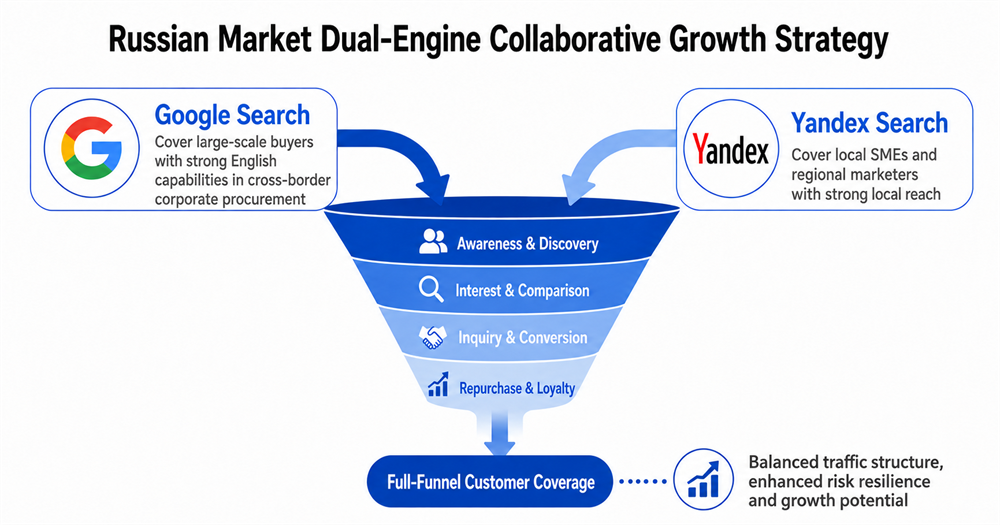
For foreign trade enterprises targeting the Russian and Central Asian markets, Google and Yandex are not mutually exclusive options, but rather complementary dual traffic engines. Google is better at reaching multinational corporate procurement teams and large buyers with strong English proficiency, who are accustomed to searching for global suppliers in English; Yandex, on the other hand, covers local Russian SMEs and regional distributors. These buyers rely more on local search engines to find suppliers, representing an incremental group that most enterprises tend to overlook. Only through a synergistic layout of both can you cover all tiers of clients—from large buyers to small and medium-sized distributors—and avoid a single-channel traffic structure.
Xiamen First Page: Full-Funnel Technical Capabilities for Multi-Engine Layouts
As a Google Premier Partner for 11 consecutive years, Xiamen First Page boasts 20 years of experience in foreign trade digital marketing, having served over ten thousand foreign trade enterprises in total. In terms of global multi-regional search engine layouts, we possess mature technical reserves and localized operational capabilities. We are not only proficient in full-system Google optimization but also have a deep mastery of the algorithmic rules and operational methods of regional mainstream search engines like Yandex, enabling us to provide enterprises with "Google + Regional Engine" synchronized multi-engine optimization services.
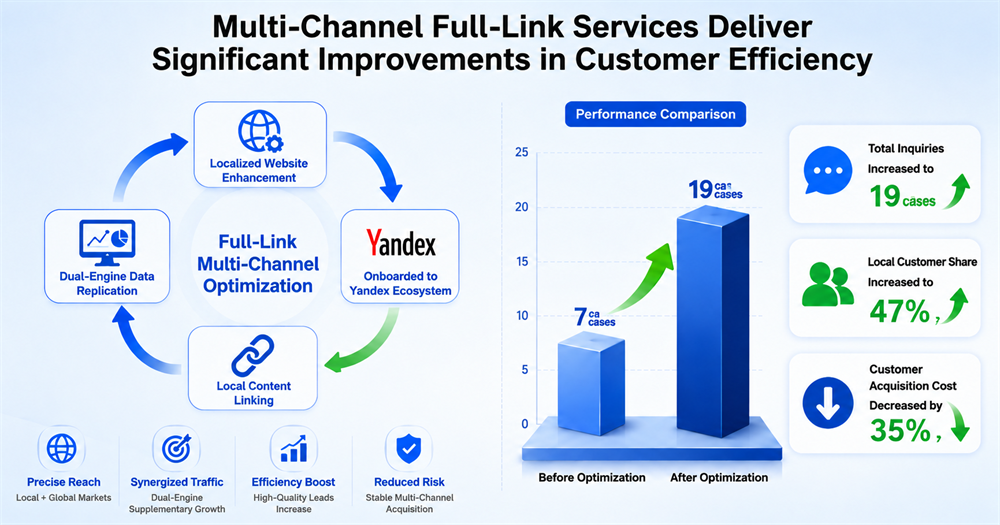
For the Russian-speaking market, our services cover the entire funnel—from Russian site localization transformation, Yandex ecosystem registration, and local content production, to Russian-speaking region backlink building and dual-engine data synchronization reviews. This avoids the inefficient practice of using one set of content for all search engines and truly achieves full-traffic coverage in regional markets.
Practical Case Study
An industrial pipe fittings enterprise in Jiangsu, focusing on the Russian-speaking market, initially only optimized its Russian independent website for Google. After 6 months of operation, it averaged 7 valid inquiries per month, mostly from large multinational buyers. Local SME distributors accounted for less than 15%, resulting in a narrow customer structure and weak risk resistance.
After partnering with Xiamen First Page, the team customized a dual-engine synergy optimization plan for them:
First, completing the Yandex Business registration and map location binding to supplement local entity signals;
Second, restructuring the site's Russian content by replacing machine-translated text and producing localized industry technical content;
Third, deploying backlinks on vertical industry platforms and directory sites in the Russian-speaking region, boosting the Yandex site's authority through in-depth local Russian backlink building.
After 4 months of optimization, the enterprise's Russian site saw its Yandex organic traffic share reach 58%, and the total average monthly valid inquiries increased to 19. The proportion of inquiries from local SME distributors rose to 47%, resulting in a more balanced customer structure and a 35% decrease in overall customer acquisition costs.
The search ecosystems of the Russian and Central Asian markets possess distinct regional characteristics. Blindly applying Google's optimization experience cannot adapt to Yandex's rules and will lead to missing out on substantial local traffic. For foreign trade enterprises deeply penetrating the Russian-speaking region, only by understanding the core differences between various search engines and adopting a dual-engine synergy growth strategy can they fully tap into regional market potential. Xiamen First Page will continue to refine its technical reserves for global multi-channel search engines, helping foreign trade enterprises adapt to the search ecosystems of different regional markets and achieve precise and efficient overseas customer acquisition.